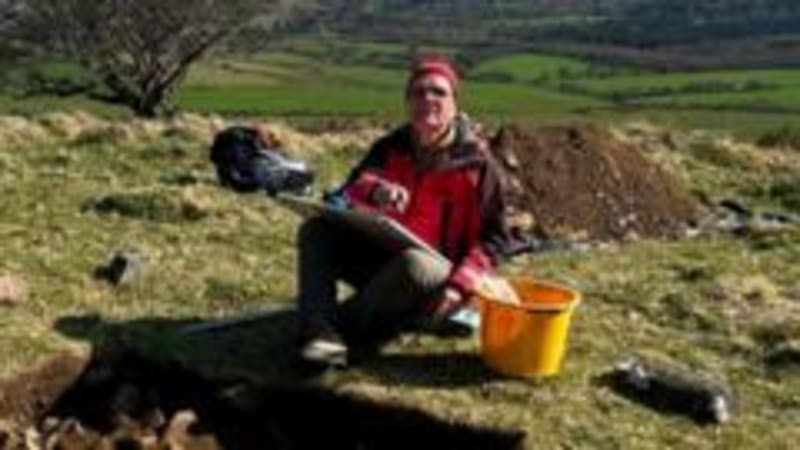
600 Hidden Homes Reveal Lost Bronze Age City in Irish Mountains
A groundbreaking archaeological discovery challenges everything we thought we knew about prehistoric urban settlements in Ireland. Researchers have uncovered a massive hilltop community that predates Viking towns by millennia.
In a stunning revelation that rewrites Ireland's ancient urban history, archaeologists have discovered an extraordinary prehistoric settlement containing over 600 roundhouses, potentially representing the first proto-town ever found in the region.
Dr. Dirk Brandherm and his research team have identified an unprecedented large-scale community within the Brusselstown Ring, nestled in the southwestern Wicklow Mountains. Located in an area known as the Baltinglass Hillfort Cluster, this extraordinary site dates back to approximately 1200 BC during the Late Bronze Age, dramatically challenging previous assumptions about early human settlements.
Using advanced techniques like aerial surveys and photogrammetry mapping, researchers determined that 98 house platforms exist within the inner enclosure, with an additional 500 located between two defensive ramparts. The settlement's complexity is remarkable - spanning multiple hills and featuring sophisticated defensive structures that suggest a highly organized society.
The discovery fundamentally transforms archaeological understanding of Bronze Age community structures. Previously, researchers believed settlements consisted only of small hamlets with one to five dwellings. Now, the Brusselstown Ring demonstrates a much more complex social organization, with Dr. Brandherm describing it as a potential 'proto-town' that existed a remarkable 2,000 years before Viking settlements.
Among the site's most intriguing features is a unique stone-lined, boat-shaped chamber that archaeologists believe might have been an advanced water cistern. This structure, potentially fed by an uphill stream, represents a potential 'first' in Irish archaeological records and demonstrates sophisticated water management techniques previously unknown for this historical period.
Published in the prestigious peer-reviewed journal Antiquity, the study emphasizes the site's exceptional significance. 'Given its extraordinary size, occupation density, and architectural complexity, Brusselstown Ring represents a unique case within both the Baltinglass hillfort cluster and the broader Atlantic Archipelago,' the research notes.
As researchers prepare for further test excavations in 2024, the Brusselstown Ring promises to revolutionize our understanding of prehistoric Irish society. This remarkable discovery suggests that complex, organized urban living existed in Ireland far earlier than previously imagined, opening exciting new chapters in our understanding of human social development.
Based on reporting by BBC World
This story was written by BrightWire based on verified news reports.
Spread the positivity! 🌟
Share this good news with someone who needs it
More Good News
 🚀 Innovation
4,500-Year-Old Sun Temple Emerges from Nile's Sands, Revealing Ancient Egyptian Worship
 🚀 Innovation
Medieval Women's Cemetery Reveals Surprising Secrets of Early Religious Life
🚀 Innovation