AI Breakthrough Promises Safer Communities Through Better Flood Prediction
Cornell researchers have developed an innovative AI-powered approach to flood prediction that could revolutionize how we protect our communities from climate-related disasters. By combining artificial intelligence with traditional methods and using regional data analysis, scientists are paving the way for smarter, more resilient infrastructure planning.
In an exciting development for climate adaptation, researchers at Cornell University are harnessing the power of artificial intelligence to keep our communities safer in an changing world. Their groundbreaking work offers hope for better protecting homes, roads, and bridges from increasingly severe flooding events.
The innovative study, published in the Journal of Hydrology, demonstrates how AI can significantly improve our ability to predict future floods—a critical step toward building more resilient communities. Led by doctoral student Sandeep Poudel and Associate Professor Scott Steinschneider, the research team is pioneering new approaches that combine cutting-edge technology with traditional engineering wisdom.
"We're entering a new era of climate adaptation," explains Poudel. "By understanding the limitations of our current models, we can develop better tools to protect communities and infrastructure for generations to come."
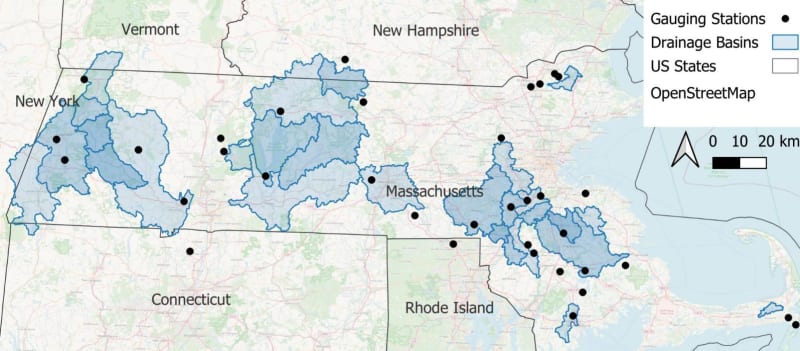
The researchers created an ingenious "virtual hydrolab"—a sophisticated simulation containing 1,000 years of climate data, including temperature, precipitation, soil moisture, and runoff patterns. This digital testing ground allowed them to evaluate different flood prediction models under both current and future climate conditions, something never before possible with real-world data alone.
The results revealed promising news: AI-based models showed superior performance in predicting flood patterns. Even more encouraging, the team discovered that analyzing data across entire regions, rather than individual sites, produces remarkably more stable and reliable predictions. This "bigger picture" approach gives urban planners and engineers a powerful new tool for making informed decisions about infrastructure investments.
Rather than viewing this as a competition between old and new methods, the researchers emphasize the importance of collaboration. "This isn't about replacing physics-based models," Steinschneider notes optimistically. "It's about recognizing the strengths of different approaches and continuing to refine them together."
The hybrid model combining traditional physics-based calculations with AI learning represents an exciting middle ground, suggesting that the future of flood prediction lies in thoughtful integration of multiple approaches.
This research comes at a crucial time, as communities worldwide seek better ways to adapt to changing climate conditions. The team's findings offer a roadmap for improving how we design and build infrastructure, ensuring that tomorrow's bridges, roads, and dams are better equipped to handle whatever nature brings.
The study's emphasis on regional patterns over site-specific predictions is particularly encouraging for resource-constrained communities. By pooling data across multiple river basins and watersheds, planners can make more confident decisions even when local data is limited.
"This work represents a significant step forward in our ability to prepare for and adapt to climate change," says Poudel. "We're not just identifying problems—we're developing practical solutions that can be implemented today to protect communities tomorrow."
As the research continues, the team remains committed to refining both AI and traditional models, ensuring that engineers and planners have the most reliable tools possible. This collaborative, forward-thinking approach embodies the best of scientific progress: acknowledging challenges while actively creating solutions that make our world safer and more resilient.
More Images


Based on reporting by Phys.org
This story was written by BrightWire based on verified news reports.
Spread the positivity! 🌟
Share this good news with someone who needs it
More Good News
 💡 Solutions
MIT Professor Shows How AI Could Power Cleaner, More Efficient Energy Grids
 💡 Solutions
Yale Study Maps How Diverse Groups Build 'Everyday Peace' in Mauritania
 💡 Solutions
Climate Research Group Steps Up to Continue Vital Disaster Tracking Database
Joke of the Day
Why did the dog apply for a job at the bank?
Explore Categories
Quote of the Day
"The greatest thing you'll ever learn is just to love and be loved in return."
— Moulin Rouge (from the film, popularized by Ewan McGregor)