Airlines Could Cut Emissions Up to 75% Using Three Simple Strategies, Study Shows
Groundbreaking research reveals that aviation could dramatically reduce its carbon footprint by 50-75% through practical measures already within reach. Even better news: simply optimizing how we use existing aircraft fleets could immediately slash global emissions by 11% without reducing flight capacity.
The aviation industry has just received a roadmap for dramatic emissions reductions that doesn't require waiting for futuristic technology or grounding planes. A comprehensive new study analyzing over 27 million flights worldwide has discovered that airlines could cut their carbon emissions by an impressive 50-75% by implementing three achievable strategies that are available right now.
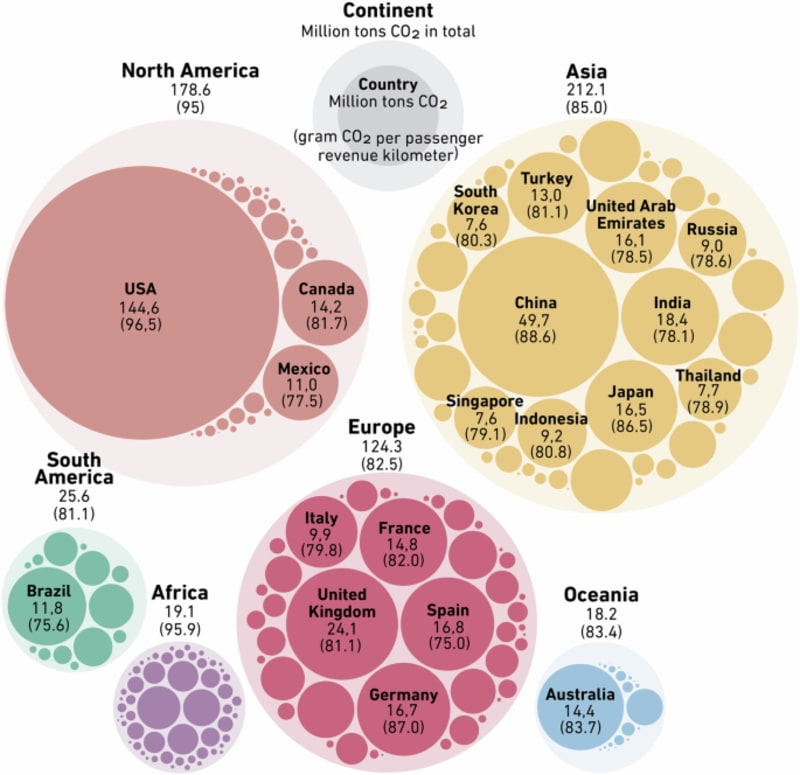
The research, which examined flights connecting more than 26,000 city pairs throughout 2023, brings genuinely exciting news for environmentally conscious travelers and the planet alike. By flying only the most fuel-efficient aircraft models, adopting all-economy seating configurations, and maximizing passenger loads to 95%, the aviation sector could achieve emission reductions that once seemed impossible without revolutionary new technologies.
Perhaps most encouraging is the study's finding that we don't need to wait for a complete fleet overhaul to make meaningful progress. Simply by operating existing routes at their already-demonstrated best efficiency levels, global aviation emissions could drop by an impressive 10.7% almost immediately. This means airlines already have the tools and knowledge to make a substantial difference—they just need to apply best practices more consistently across their operations.
The research revealed fascinating variations in efficiency across the globe. Some regions are already showing us what's possible: Brazil, India, and Southeast Asia are leading the way with notably high efficiency rates, proving that smart operational choices can deliver real results. Meanwhile, the study identified specific opportunities for improvement in regions like Africa, Australia, and Norway, where efficiency gains could be most impactful.
Individual routes showed remarkable differences too, with efficiency varying from as low as 32 grams of CO2 per passenger kilometer on the best routes to 890 grams on the least efficient ones. This wide variation actually represents tremendous opportunity—it shows there's enormous room for improvement by learning from and replicating what's already working well on the most efficient routes.
The aviation industry has historically made steady progress on efficiency, with emissions per passenger kilometer dropping from 280 grams in 1980 to 90 grams in 2019. Passenger load factors have also improved impressively, climbing from 63% to over 82% during the same period. This new research suggests we can accelerate that positive trend significantly.
What makes these findings particularly hopeful is that efficiency-focused policies could reduce fuel consumption quickly without limiting air transport capacity or accessibility. Travelers wouldn't need to fly less; airlines would simply need to fly smarter. This approach sidesteps one of the biggest challenges in climate action—the perceived need to sacrifice convenience or economic activity for environmental benefits.
While the aviation industry continues working on longer-term solutions like sustainable aviation fuels and next-generation aircraft designs, this research demonstrates that we already possess powerful tools to make substantial progress today. The path to cleaner skies is clearer than ever, and it's remarkably achievable with existing technology and knowledge.
For an industry responsible for roughly 4% of human-driven climate impact, these potential reductions represent a significant opportunity to contribute to global climate goals while continuing to connect people and places around the world.
More Images

Based on reporting by Reddit - Science
This story was written by BrightWire based on verified news reports.
Spread the positivity! 🌟
Share this good news with someone who needs it
More Good News
 💡 Solutions
Abu Dhabi Welcomes Ten Visionary Innovators Tackling Global Food Security Challenges
 💡 Solutions
The Green Growth Revolution: 92 Countries Prove Economy and Climate Can Both Win
 💡 Solutions
Youth Leading the Way: Maine Library Hosts Inspiring Climate Solutions Series
Joke of the Day
Why did the librarian get kicked out of class?
Explore Categories
Quote of the Day
"Do not go where the path may lead, go instead where there is no path and leave a trail."
— Ralph Waldo Emerson