
Astronomers Make Exciting Discovery: Hidden Galaxy Reveals Itself in Deep Space
An international team of astronomers has made a thrilling discovery, uncovering a hidden galaxy where scientists previously thought none existed. Using advanced telescopes, researchers revealed a faint but beautiful low-surface-brightness galaxy 94 million light years away, demonstrating how new technology continues to unveil the universe's secrets.
In an exciting breakthrough that showcases the power of modern astronomical technology, scientists from Serbia and Russia have discovered a stunning hidden galaxy in deep space, transforming our understanding of a mysterious cosmic object.
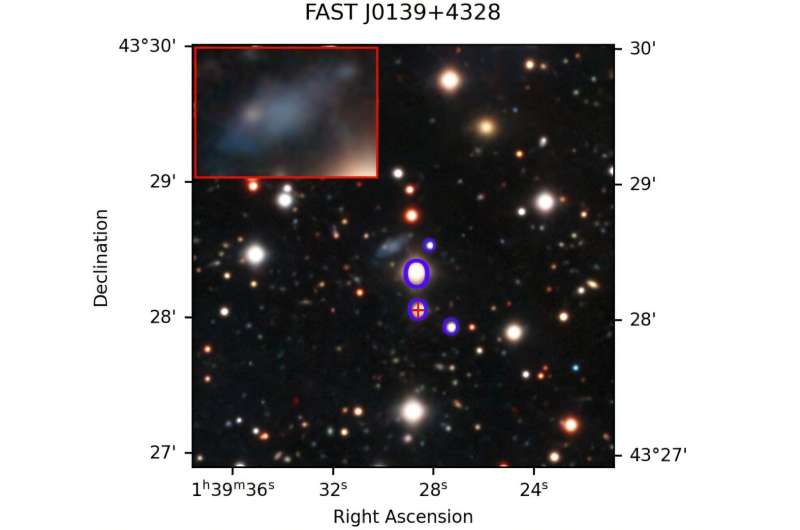
The celestial body known as FAST J0139+4328 was first detected in 2023 as an isolated cloud of hydrogen gas. Initially classified as a "dark galaxy" – a rare cosmic phenomenon with no visible stars – the object captivated astronomers who wondered about its unusual nature. But thanks to persistent scientific curiosity and cutting-edge observational techniques, the truth has now been revealed in a delightful twist.
Using the 1.4-meter Milanković and 0.6-meter Nedeljković telescopes, a dedicated team led by Ana Mitrašinović from the Astronomical Observatory in Belgrade conducted deep optical observations that unveiled something remarkable: a faint but genuine galaxy that had been hiding in plain sight all along. The discovery, published in late December 2025, shows that what scientists thought was a starless cloud is actually a beautiful low-surface-brightness (LSB) dwarf galaxy teeming with stars.
This enchanting galaxy, located approximately 94 million light years from Earth, contains about 7.2 million solar masses worth of stars – a cosmic treasure that was simply too faint for previous instruments to detect. The researchers also found hydrogen-alpha emissions, confirming the galaxy's stellar activity and establishing its physical connection to the hydrogen cloud originally observed.
What makes this discovery particularly fascinating is the galaxy's extreme gas richness. With a gas-to-stellar mass ratio of approximately 11.5, FAST J0139+4328 represents an extraordinarily gas-rich system, offering astronomers a unique laboratory for studying how galaxies form and evolve. These diffuse stellar systems, with their billions of stars spread across vast distances, help us understand the full diversity of cosmic structures in our universe.
The breakthrough underscores an important message of hope and persistence in scientific research: just because we can't see something with current technology doesn't mean it isn't there. As our telescopes become more sophisticated and our observational techniques improve, the universe continues to reveal wonders that were previously invisible to us.
Dr. Mitrašinović and her international team emphasize that their discovery highlights the critical importance of deep optical follow-up observations. Many supposedly "dark" objects in space may simply be awaiting better instruments and more patient observation to reveal their true nature.
Looking ahead, the research team plans further spectroscopic observations to learn even more about this fascinating galaxy's characteristics and evolutionary history. Each new piece of information will help astronomers better understand not just this particular galaxy, but the countless similar objects that likely exist throughout the cosmos, waiting to be discovered.
This discovery reminds us that the universe still holds countless surprises, and that human ingenuity and collaboration across borders continue to push the boundaries of what we know about our cosmic home. The night sky remains full of mysteries waiting to be solved by the next generation of curious minds and powerful telescopes.
More Images
Based on reporting by Phys.org
This story was written by BrightWire based on verified news reports.
Spread the positivity! 🌟
Share this good news with someone who needs it
More Good News
 🚀 Innovation
Philanthropists Launch Revolutionary Space Telescope to Democratize Cosmic Discovery
 🚀 Innovation
Scientists Make Exciting Breakthrough in Uncovering Leonardo da Vinci's DNA
 🚀 Innovation
New Observatory Makes Stunning Discovery in First Week of Stargazing!
Joke of the Day
Why did the librarian get kicked out of class?
Explore Categories
Quote of the Day
"Do not go where the path may lead, go instead where there is no path and leave a trail."
— Ralph Waldo Emerson