
Breakthrough Framework Makes Educational Video Games More Engaging and Human-Centered
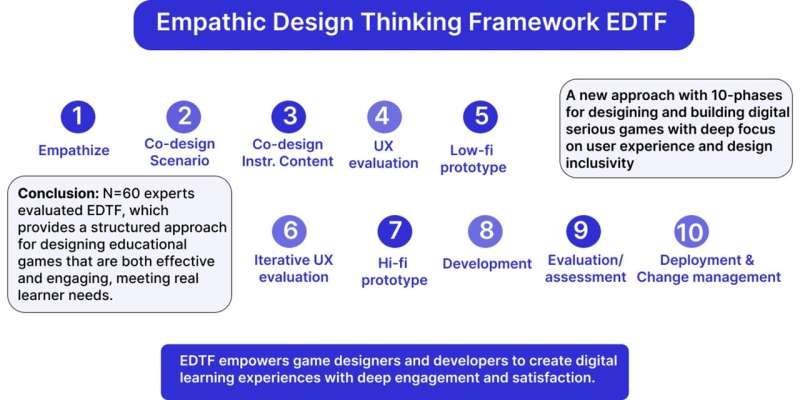
Researchers have developed an innovative 10-phase framework that transforms educational video games into emotionally engaging, empathetic learning experiences. This groundbreaking approach bridges psychology, neuroscience, and game design to create games that truly connect with students and make learning more meaningful and fun.
Imagine a classroom where learning feels less like work and more like an adventure—where students are genuinely excited to engage with educational content because it speaks to their hearts as well as their minds. Thanks to groundbreaking research from the Open University of Catalonia, this vision is becoming a reality.
Researcher Raluca Ionela Maxim has developed something truly special: the Empathic Design Thinking Framework, a comprehensive approach that's revolutionizing how we create educational video games. Rather than treating students as passive recipients of information, this framework puts empathy at the very heart of game design, ensuring that every element resonates with how young people actually think, feel, and learn.
"The idea is to support a transition from traditional educational models towards more useful and motivational experiences, such as games that truly connect with students," Maxim explains enthusiastically. Her vision is inspiring: games that not only develop cognitive skills but make learning genuinely meaningful by blending theory and practice in ways that feel natural and exciting.
What makes this framework so remarkable is how it transforms empathy from an abstract concept into concrete action. Working under the supervision of Joan Arnedo from the Learning, Media and Entertainment Research Group, Maxim has created a structured 10-phase process that guides developers from initial user understanding all the way through to final assessment. Each phase builds upon the last, ensuring that the final product genuinely serves students' needs.
The framework begins with deep empathy—really listening to students and teachers to understand their authentic experiences and motivations. It then moves through collaborative design phases where educators, students, and designers work together as partners, creating narratives and learning journeys that feel relevant and emotionally meaningful to the people who'll actually use them.
What's particularly exciting is the iterative nature of this approach. Rather than building a complete game and hoping it works, the framework encourages continuous testing and refinement. Simple prototypes are created early, allowing teams to gather feedback and make improvements before significant resources are invested. This means fewer disappointments and more successful outcomes for everyone involved.
The framework also bridges important gaps between disciplines, connecting insights from psychology and neuroscience with practical game design. This interdisciplinary approach ensures that games aren't just entertaining—they're also grounded in solid understanding of how people learn and what motivates them.
Maxim emphasizes that this approach helps development teams move "from designing based on assumptions to designing based on real human experience." This shift is transformative, creating learning experiences that feel authentic rather than artificial, engaging rather than obligatory.
The potential applications are vast and inspiring. From elementary schools to corporate training environments, this framework offers a roadmap for creating educational games that students actually want to play. By combining challenges and rewards in ways that fuel both internal motivation and external recognition, these games can help learners apply knowledge in real-life situations.
As educational technology continues to evolve, frameworks like this one represent the future of learning—a future where education is more human, more connected, and more effective. By placing empathy at the center of design, we're not just creating better games; we're creating better learning experiences that honor the full humanity of every student.
More Images



Based on reporting by Phys.org - Technology
This story was written by BrightWire based on verified news reports.
Spread the positivity! 🌟
Share this good news with someone who needs it
More Good News
 🚀 Innovation
Young Minds Shine as Elementary Students Embrace the Joy of Robotics
 🚀 Innovation
Egyptian Startup Empowers Thousands of Teens with Business Skills Through New Funding
 🚀 Innovation
Google Classroom Brings Podcast Magic to Education with AI-Powered Learning Tool
Joke of the Day
Why don't scientists trust atoms?
Explore Categories
Quote of the Day
"The only way to do great work is to love what you do."
— Steve Jobs