Breakthrough Research Brings Hope for Personalized Dyslexia Support
Scientists at Kyushu University have developed an innovative approach to understanding dyslexia by safely simulating its effects in healthy volunteers. This groundbreaking research could lead to personalized interventions that help millions of people with dyslexia reach their full potential through targeted, effective support.
In an exciting development that promises to transform support for people with dyslexia, researchers at Kyushu University have created a safe, innovative method to better understand this common learning difference. Their groundbreaking approach could pave the way for personalized interventions that help each individual thrive.
Dyslexia affects approximately seven percent of people worldwide, presenting challenges with reading and spelling despite normal intelligence and education. The new research, published in Frontiers in Human Neuroscience, offers fresh hope for the estimated hundreds of millions of people navigating these difficulties.
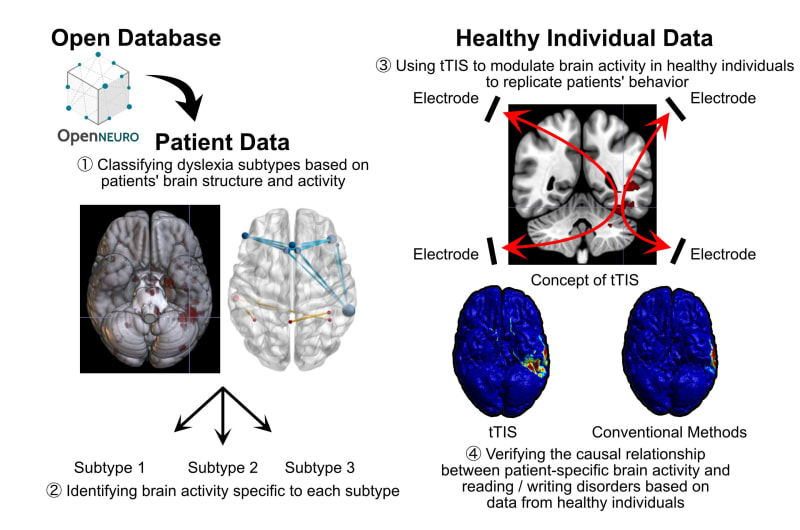
The research team developed an ingenious two-step approach that represents a major leap forward in dyslexia research. First, they analyzed brain imaging data from both children and adults, identifying specific patterns of brain activity associated with different dyslexia profiles. This data-driven method revealed that dyslexia isn't a single condition but comprises several subtypes, each with distinct characteristics.
What makes this research particularly promising is the second step: safely recreating these brain patterns in healthy volunteers using an advanced technique called transcranial temporal interference stimulation, or tTIS. This gentle, non-invasive method uses weak electrical currents delivered through scalp electrodes to temporarily mimic dyslexia-related brain activity, allowing researchers to directly observe how specific brain patterns relate to reading behaviors.
"This approach allows us to directly examine how specific patterns of brain activity relate to reading behavior, helping to accelerate the development of more personalized interventions," explained Daniel Gallagher, the study's first author and postdoctoral fellow at Kyushu University.
The implications of this research are wonderfully far-reaching. By identifying distinct dyslexia subtypes based on brain patterns, the findings could help parents, educators, and healthcare providers understand exactly why someone experiences particular challenges and, most importantly, what specific support strategies will work best for them.
Associate Professor Shinri Ohta emphasized the transformative potential of this work: "Clearer brain-based subtypes could help parents and educators understand why a child struggles in a particular way and what support works best."
This personalized approach represents a significant shift from traditional one-size-fits-all interventions. By matching support strategies to individual brain profiles, children and adults with dyslexia could receive earlier, more effective help, potentially reducing academic difficulties and supporting better mental health outcomes.
The research team acknowledges that careful validation is still needed, particularly for the brain stimulation protocols. However, their innovative human model overcomes a major obstacle in dyslexia research: unlike many neurological conditions, dyslexia cannot be studied in animal models because reading and writing are uniquely human abilities.
Looking ahead, this research opens exciting possibilities for developing targeted therapies and educational strategies. By understanding the specific brain mechanisms underlying different dyslexia subtypes, researchers and clinicians can work toward interventions that address root causes rather than just symptoms.
For the millions of individuals with dyslexia and their families, this research brings genuine hope for a future where everyone receives the specific support they need to succeed academically, professionally, and personally. As our understanding of dyslexia's neurological foundations deepens, so too does our ability to help every person with dyslexia unlock their full potential.
More Images


Based on reporting by Medical Xpress
This story was written by BrightWire based on verified news reports.
Spread the positivity! 🌟
Share this good news with someone who needs it
More Good News
 🚀 Innovation
Ogun State Revolutionizes Education with AI-Powered Learning Platform
 🚀 Innovation
Harvard and XED Unite to Empower Education Leaders Across the Globe
 🚀 Innovation
Scientists Create Promising New Treatment for Depression Without Hallucinogenic Effects
Joke of the Day
Why did the dog apply for a job at the bank?
Explore Categories
Quote of the Day
"The greatest thing you'll ever learn is just to love and be loved in return."
— Moulin Rouge (from the film, popularized by Ewan McGregor)