China Tests Reusable Rocket in Space Race Breakthrough
China just fired up its new Long March 12B reusable rocket, marking another major step in the country's race to make space launches cheaper and more frequent. The successful test brings China closer to joining an elite club of nations capable of landing and reusing rockets.
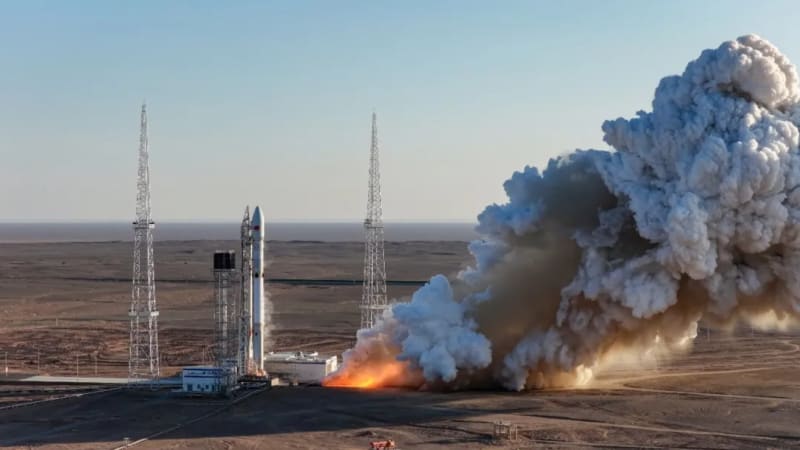
China's space program hit a major milestone Friday when engineers successfully tested a new reusable rocket that could transform how the nation launches satellites into orbit. The Long March 12B rocket roared to life at the Jiuquan Satellite Launch Center in northwest China, completing a crucial static fire test that simulates everything except actual liftoff.
The test marks China's latest push to master rocket reusability, a technology that could slash launch costs by allowing boosters to land and fly again instead of burning up after one use. The China Aerospace Science and Technology Corporation announced the successful firing, noting that engineers tested every critical step from fueling to ignition timing.
The Long March 12B represents a fresh approach for China's space ambitions. Standing four meters wide and powered by kerosene and liquid oxygen, the rocket can theoretically carry about 20 tons to low Earth orbit. That's enough muscle to launch dozens of satellites in a single flight.
This rocket joins its sibling, the Long March 12A, which attempted China's first orbital booster recovery in December. While that rocket reached space successfully, the landing attempt failed during descent. The new 12B design uses different fuel and a slightly wider body, potentially improving its chances of sticking the landing.
The Ripple Effect
China isn't pursuing reusable rockets just for bragging rights. The country plans to launch massive satellite constellations, including the government-backed Guowang network and the Shanghai-supported Qianfan system, which will require hundreds of launches over the next decade.
Reusable rockets could cut launch costs by up to 90%, making these ambitious projects financially viable. China has filed paperwork for constellations totaling more than 200,000 satellites, a staggering number that would require launching almost daily to achieve.
The technology race extends beyond China's borders. Multiple Chinese companies are preparing test flights of potentially reusable rockets this year, including the Pallas-1, Kinetica-2, Tianlong-3, and Nebula-1. Meanwhile, state-owned contractors are developing even more advanced engines that could power larger rockets capable of carrying heavier payloads.
The timing matters globally too. As satellite internet and space-based services become essential infrastructure, countries that master affordable launch capabilities will shape the future of space commerce. China's rapid progress in reusability puts it on track to compete directly with established players who pioneered the technology.
Engineers haven't announced when the Long March 12B might attempt its first actual flight, but the successful static fire test suggests that day could come soon. Each test brings China closer to routine rocket landings, transforming what was once science fiction into standard operating procedure.
The race to reusable space isn't slowing down.
More Images


Based on reporting by SpaceNews
This story was written by BrightWire based on verified news reports.
Spread the positivity! 🌟
Share this good news with someone who needs it


