China's Bold Energy Experiment: Turning Industrial Heat into Green Power
China launches innovative supercritical CO2 power generator at steel plant, promising significant efficiency gains. The groundbreaking technology could revolutionize industrial waste heat recovery.
In the mountainous southwest of China, a technological marvel is quietly transforming industrial energy production. The Chaotan One generator, installed at a Guizhou province steel plant, represents an ambitious leap forward in waste heat recovery technology.
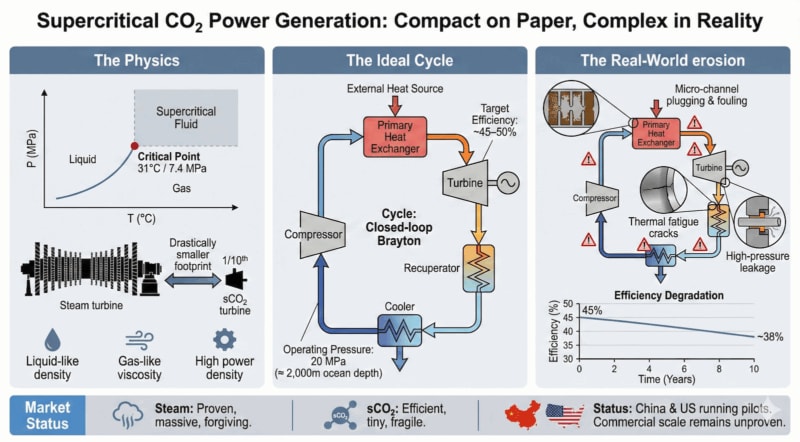
This pioneering system harnesses supercritical carbon dioxide to convert industrial waste heat into electricity, boasting remarkable efficiency improvements between 20-30% compared to traditional steam-based systems. Each unit generates approximately 15 MW, with potential configurations reaching 30 MW of clean, recycled power.
While the achievement is impressive, China's technological development strategy suggests caution. The nation is known for its experimental approach of "crossing the river by feeling for stones" - testing innovative technologies without guaranteed success. This method allows China to learn rapidly, discarding unsuccessful experiments while scaling promising solutions.
Supercritical CO2 power systems represent a fascinating thermal generation technique. By exploiting carbon dioxide's unique properties at extreme temperatures and pressures - approximately 31° Celsius and 73 atmospheres - the technology creates a fluid state between gas and liquid, enabling more compact and potentially more efficient energy generation.
The generator's potential lies in its compact turbomachinery design. Because supercritical CO2 maintains high density while flowing like a gas, engineers can create smaller, more efficient power generation systems. However, the critical question remains: Can this technology prove durable and economically viable in long-term industrial applications?
China's track record suggests measured optimism. Previous technological experiments like small modular nuclear reactors and hydrogen transportation have not scaled as dramatically as battery electric vehicles. This indicates that while China is willing to explore cutting-edge technologies, commercial robustness remains the ultimate test.
The Chaotan One project represents more than just an engineering experiment - it's a potential blueprint for industrial energy transformation. By recovering waste heat that would otherwise be lost, this technology could significantly reduce industrial carbon emissions and improve overall energy efficiency.
As the world seeks sustainable energy solutions, China's bold experiment offers a glimpse into potential future technologies. While success is not guaranteed, the willingness to innovate and learn represents a crucial step toward more efficient, cleaner industrial energy production.
Based on reporting by CleanTechnica
This story was written by BrightWire based on verified news reports.
Spread the positivity! 🌟
Share this good news with someone who needs it