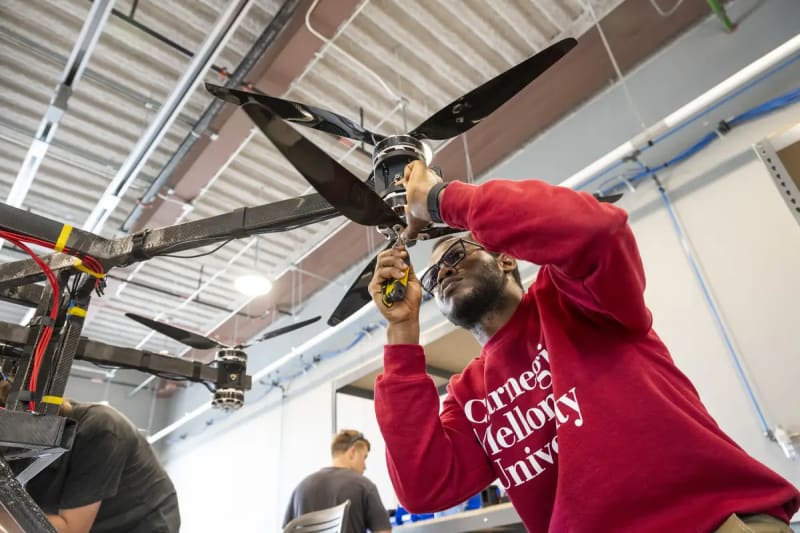
CMU's New Robotics Center Tests Lifesaving Rescue Drones
Carnegie Mellon's new Robotics Innovation Center is creating autonomous drones and tiny robots that could revolutionize search-and-rescue missions after disasters. These innovations will help save lives without putting human rescuers in danger.
📺 Watch the full story above
When disaster strikes and people are trapped under rubble or lost in wilderness, every second counts. Now, researchers at Carnegie Mellon University have a powerful new facility to perfect robots that could save lives when human rescuers can't safely reach survivors.
The Robotics Innovation Center in Pittsburgh is becoming a testing ground for search-and-rescue technology that sounds like science fiction. Swarms of drones equipped with day and night vision cameras can search vast areas, just like the human search lines you see in movies, but faster and safer.
Steven Willits, a project scientist at CMU's Airlab, explains how these autonomous drones work together to explore everywhere from collapsed buildings to underground mines. The drones act as scouts, sending back crucial information about dangers like downed power lines or unstable structures before human rescuers arrive.
The new facility features two massive drone cages for testing. The indoor cage uses motion capture cameras to track drone movements with sub-millimeter accuracy. The outdoor cage can safely test larger drones using GPS technology that's accurate to within centimeters.
That precision matters enormously. Researchers need to know exactly how their drones perform in controlled environments before deploying them in chaotic disaster scenes where a navigation error could mean the difference between finding someone and missing them entirely.
The Ripple Effect
The center isn't just about flying robots. Professor Aaron Johnson's team created Zippy, the world's smallest and fastest two-legged robot at just 1.5 inches tall. This tiny marvel can squeeze through spaces that dogs and larger robots simply can't reach, potentially finding survivors trapped in tight gaps within collapsed structures.
Johnson emphasizes that access is everything in rescue situations. His team designs robots that can climb steep cliffs, dig through debris, and navigate terrain too dangerous for humans. Each robot carries cameras and microphones to gather critical information about survivors and hazards.
The outdoor testing area will let researchers create realistic disaster scenarios with real bushes, trees, and varied terrain. This real-world practice environment means the robots will be better prepared when actual emergencies happen.
The facility represents more than just technological advancement. It's transforming a former steel mill site in Hazelwood Green into a hub for innovation that could protect both disaster survivors and the brave people who rescue them.
These robots won't replace human rescuers, but they'll make rescue missions safer and more effective when every moment matters most.
Based on reporting by Google: robotics innovation
This story was written by BrightWire based on verified news reports.
Spread the positivity!
Share this good news with someone who needs it


%2Ffile%2Fattachments%2Forphans%2FKrugerfloods-3_785220.jpg)