ESA's Comet Hunter Gets Earlier Launch and Power Boost
A European spacecraft designed to chase pristine comets just got bumped up by three years and gained serious new capabilities. The mission will wait in space for the perfect untouched comet from the outer solar system.
A scheduling setback for one space mission just became a major win for comet science.
The European Space Agency's Comet Interceptor was facing a frustrating three-year delay after its ride-share partner, the Ariel exoplanet mission, pushed its launch from 2029 to 2031. The spacecraft would have been ready in 2028, meaning teams would sit idle while costs piled up for storing the completed mission.
Instead, ESA found a better solution. The agency secured an earlier solo launch between August 2028 and July 2029 by hitching a ride with a commercial satellite headed to geostationary orbit.
The new arrangement transforms what looked like bad news into an unexpected upgrade. The spacecraft will now carry significantly more fuel, boosting its ability to change course from 600 meters per second to roughly 1,000 meters per second.
That extra power matters enormously for the mission's success. Comet Interceptor will park itself at a gravitational balance point 1.5 million kilometers from Earth, waiting patiently for scientists to spot a pristine long-period comet making its first journey from the outer solar system.
With the improved fuel capacity, the odds of missing a good target over six years drop from 20% to less than 10%. Project scientist Michael Kueppers calls the change "an upgrade from economy to business class."
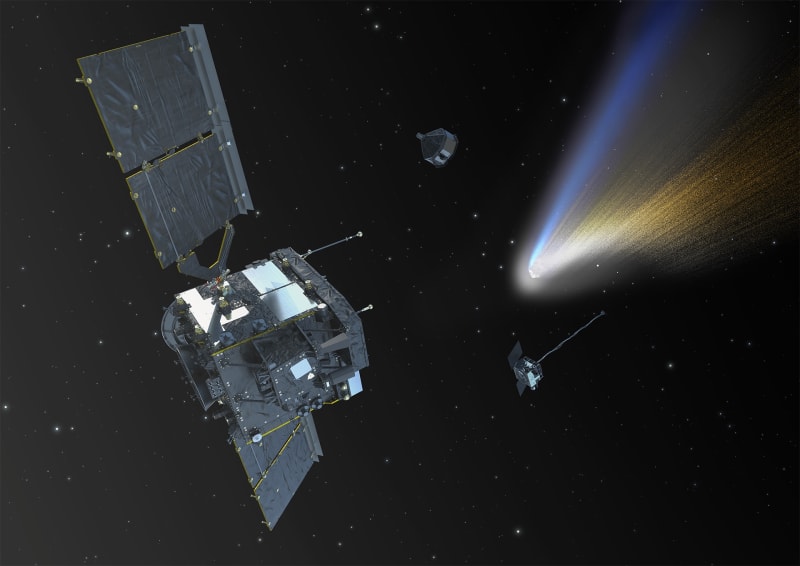
The mission carries three separate spacecraft that will split apart during the comet flyby, capturing images and data from multiple angles as they scream past at 70 kilometers per second. One probe comes from Japan's space agency, making this a truly international effort.
Scientists hope to intercept what they call a "dynamically new comet," one so fresh from deep space that it's essentially unchanged since the solar system formed 4.6 billion years ago. These objects are frozen time capsules containing clues about how planets, including Earth, came to be.
The Bright Side
What makes this story remarkable is how problem-solving turned a bureaucratic headache into better science. The mission team refused to accept a wasteful three-year wait and instead found a path that's faster and more capable.
The additional launch costs will likely be offset by avoiding years of storage expenses and keeping talented teams engaged and employed. Sometimes the detour really is the better route.
Space agencies often face these scheduling puzzles with billion-dollar missions that take decades to plan. Finding creative solutions that improve outcomes rather than just shuffle problems shows how mature space programs are becoming.
And there's something wonderfully optimistic about building a spacecraft before you even know what it will study. The team is so confident that pristine comets are out there waiting to be discovered that they're willing to launch first and pick a target later.
When Comet Interceptor reaches its parking spot in space, it will join a small club of missions designed to study objects we haven't even found yet, ready to spring into action when astronomers spot something extraordinary heading our way.
More Images


Based on reporting by SpaceNews
This story was written by BrightWire based on verified news reports.
Spread the positivity! 🌟
Share this good news with someone who needs it