Hawaii Astronomers Discover Most Massive Black Hole Gas Stream Ever Seen
Scientists using Hawaii's Keck Observatory have made an extraordinary cosmic discovery, unveiling the largest stream of super-heated gas ever observed flowing from a galaxy 20,000 light-years into space. This groundbreaking finding opens new windows into understanding how galaxies evolve and transform over billions of years.
In an exciting breakthrough that's rewriting what we know about the universe, astronomers working at the W. M. Keck Observatory on Maunakea, Hawaii Island have discovered something truly remarkable: the most extended stream of super-heated gas ever observed flowing from a nearby galaxy. This stunning find represents a giant leap forward in understanding how galaxies grow and change throughout cosmic history.
The discovery centers on a galaxy called VV 340a, where researchers observed vast structures of energized gas stretching an incredible 20,000 light-years from the galaxy's center. To put that in perspective, that's far enough to span a significant portion of our own Milky Way galaxy. This observation provides the clearest evidence yet that supermassive black holes can dramatically reshape their host galaxies in ways scientists are only beginning to understand.
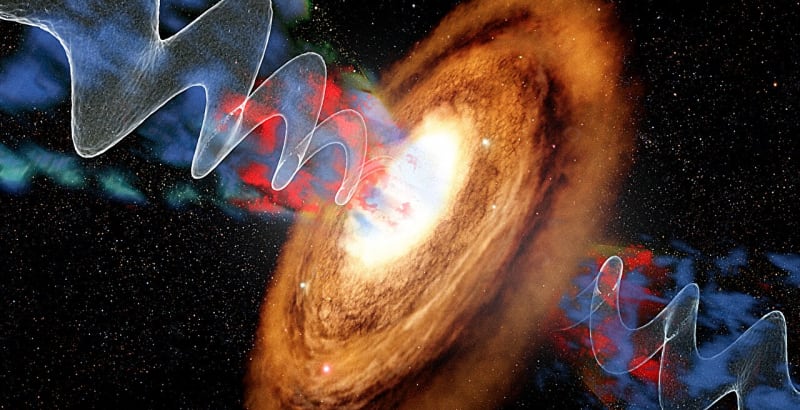
What makes this discovery particularly thrilling is how it came together. The research team, led by Justin Kader, a postdoctoral researcher at the University of California, Irvine, combined observations from three powerful telescopes to create a complete picture. The Keck Observatory's Cosmic Web Imager traced cooler gas extending well beyond the galaxy's disk, creating a striking, spear-like structure. NASA's James Webb Space Telescope captured the intensely hot coronal gas at the galaxy's heart, while the Karl G. Jansky Very Large Array revealed twisting plasma jets creating a beautiful helical, S-shaped pattern as they spiral outward.
"The Keck Observatory data is what allowed us to understand the true scale of this phenomenon," Kader explained with evident enthusiasm. The gas visible through Keck reaches the farthest distances from the black hole, meaning it also traces the longest timescales of this cosmic activity.
The research, published in the prestigious journal Science, reveals something scientists call jet precession, a rare phenomenon where the jet's direction slowly wobbles over time, like a cosmic spinning top. This wobbling jet is powerful enough to strip gas from the galaxy at a rate equivalent to forming nearly 20 suns every year, fundamentally altering the galaxy's future evolution.
The Ripple Effect
This discovery carries profound implications that extend far beyond one distant galaxy. Perhaps most intriguing is where this dramatic activity is occurring. Powerful, precessing jets like this are usually found in old, elliptical galaxies that have finished their star-forming days. Finding one in a relatively young, star-forming spiral galaxy like VV 340a was completely unexpected and challenges long-standing theories about galactic evolution.
Even more exciting, this discovery raises fascinating possibilities about our own cosmic neighborhood. "There's no clear fossil record of something like this happening in our galaxy, but this discovery suggests we can't rule it out," Kader noted. "It changes the way we think about the galaxy we live in."
The research team is already planning their next steps, pursuing deeper observations to determine whether a second supermassive black hole might be causing the jet's wobble. This could potentially lead to identifying a binary black hole system, opening yet another frontier in astronomical research.
As Vivian U, an associate scientist at Caltech/IPAC and senior author of the study, beautifully summarized: "With Keck Observatory and these other powerful observatories working together, we're opening a new window into how galaxies change over time." This collaborative approach to cosmic discovery represents the best of human curiosity and scientific cooperation, reminding us that the universe still holds countless wonders waiting to be revealed.
More Images



Based on reporting by Google News - Science
This story was written by BrightWire based on verified news reports.
Spread the positivity! 🌟
Share this good news with someone who needs it
More Good News
 Innovation
James Webb Telescope Discovers Cosmic "Platypuses" That May Reveal Galaxy Birth Secrets
 Innovation
China's Mars Rover Reveals Water Existed 750 Million Years Longer Than Expected
 Innovation
Eric Schmidt Funds 4 Major Telescopes to Revolutionize Space Discovery
DAILY MORALE
What did the thermometer say to the graduated cylinder?
EXPLORE INTEL
DAILY INSPIRATION
Hope is the thing with feathers that perches in the soul and sings the tune without the words and never stops at all.
Emily Dickinson