Hubble Makes Groundbreaking Discovery of Rare 'Cloud-9' Object, Confirming Major Theory
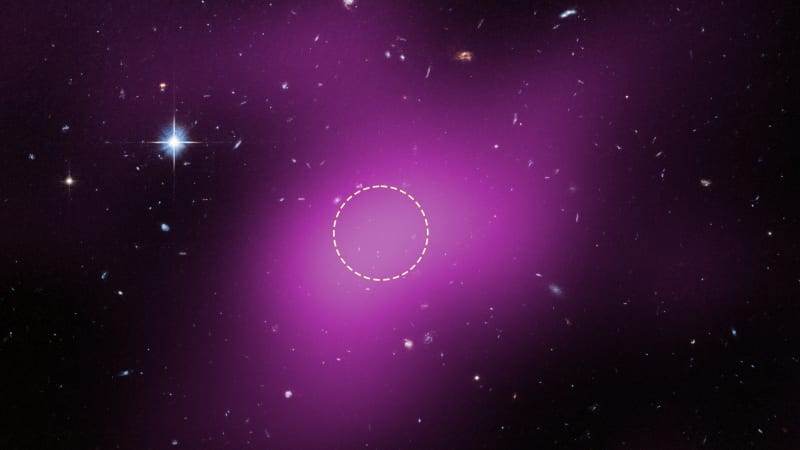
The Hubble Space Telescope has made an exciting discovery that confirms key predictions about our universe! Astronomers have found Cloud-9, a rare cosmic fossil that provides remarkable evidence supporting our understanding of dark matter and galaxy formation.
In a thrilling breakthrough for astronomy, scientists using the Hubble Space Telescope have discovered an extraordinary cosmic object that's opening new windows into understanding our universe. Named Cloud-9, this fascinating celestial phenomenon represents the first confirmed example of what researchers have been searching for: a "failed galaxy" that provides stunning validation of leading cosmological theories.
Located over 14 million light-years from Earth near the spiral galaxy Messier 94, Cloud-9 is essentially a primordial building block—a cosmic time capsule from the early universe. What makes this discovery so exciting is that it sits at a remarkable sweet spot: it contains just enough mass to hold itself together, but not quite enough to ignite star formation and become a full galaxy.
Deep Anand, the lead astronomer from the Space Telescope Science Institute, explains that this discovery beautifully confirms predictions made by the Lambda cold dark matter model, which helps scientists understand the structure and composition of our universe. "Cloud-9 lies at the very upper end of the dark halo mass range, thus allowing it to retain its gas, and therefore being visible," Anand shared enthusiastically.
The discovery journey itself showcases wonderful international scientific collaboration. Cloud-9 was initially detected three years ago by China's impressive Five-hundred-meter Aperture Spherical Telescope (FAST), followed by observations from New Mexico's Very Large Array, and finally confirmed by Hubble's Advanced Camera for Surveys. This teamwork across continents and instruments demonstrates the best of human curiosity and cooperation.
What makes Cloud-9 particularly special is its composition. The object contains about one million solar masses worth of hydrogen gas, held together by approximately five billion solar masses of dark matter. This unique combination creates what astronomers call a RELHIC—a Reionization-Limited H I Cloud—offering scientists an unprecedented "window into the dark universe," as co-author Andrew Fox describes it.
The discovery hints at an exciting possibility: our universe may be teeming with similar low-mass dark matter halos, just as theories have long predicted. Cloud-9 serves as physical proof that our current understanding of dark matter and galaxy formation is on the right track—a thrilling validation for decades of theoretical work.
Perhaps most wonderfully, Cloud-9's story may not be over. While it currently lacks stars, researchers suggest it might still gather enough mass in the future to transform into a full-fledged galaxy. The object essentially represents a moment frozen in cosmic time, showing us exactly what conditions look like at the critical threshold of galaxy formation.
This remarkable find represents more than just another discovery—it's a cosmic fossil that helps us understand the fundamental building blocks of our universe. As FAST and other advanced telescopes continue their surveys, scientists are optimistic about finding more of these rare objects, each one adding another piece to the grand puzzle of cosmic evolution.
The discovery reminds us that the universe still holds countless mysteries waiting to be unveiled, and with each finding, we gain deeper insight into the magnificent cosmos we call home.
More Images


Based on reporting by Live Science
This story was written by BrightWire based on verified news reports.
Spread the positivity! 🌟
Share this good news with someone who needs it
More Good News


DAILY MORALE
What did the thermometer say to the graduated cylinder?
EXPLORE INTEL
DAILY INSPIRATION
Hope is the thing with feathers that perches in the soul and sings the tune without the words and never stops at all.
Emily Dickinson