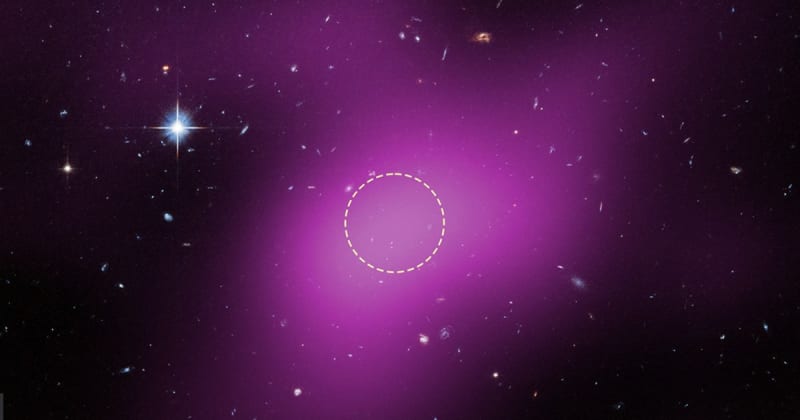
Incredible Discovery: 'Cloud 9' Reveals Secrets of Our Universe's Infancy
Astronomers have made a groundbreaking discovery of a rare cosmic object called "Cloud 9" that confirms decades of scientific theory and opens exciting new windows into understanding how galaxies form. This remarkable find represents a major leap forward in our knowledge of the universe's earliest days and the mysterious dark matter that shapes our cosmos.
📺 Watch the full story above
In a thrilling breakthrough that validates years of scientific prediction, a dedicated team of researchers has confirmed the existence of an extraordinary celestial object that promises to unlock secrets about our universe's origins. NASA has named this remarkable discovery "Cloud 9," and it's already generating excitement throughout the astronomical community.
Cloud 9 represents something scientists have long theorized about but never actually observed until now: a pristine remnant from the universe's infancy, floating serenely 14 million light-years from Earth. This "starless, gas-rich dark-matter" hydrogen cloud offers researchers an unprecedented opportunity to study the building blocks of galaxy formation in their most fundamental state.
What makes this discovery particularly exciting is that it confirms scientific models about how galaxies develop. Three years after initial detection, the powerful Hubble Space Telescope recently verified that Cloud 9 contains no stars, exactly as theory predicted. This seemingly simple observation carries profound implications for our understanding of cosmic evolution.
Alejandro Benitez-Llambay, an assistant professor at Italy's Milano-Bicocca University who led the Hubble investigation, beautifully captured the significance of this find. "In science, we usually learn more from the failures than from the successes," he explained. Rather than viewing Cloud 9 as a cosmic disappointment, scientists celebrate it as a pristine time capsule—a primordial building block that never accumulated enough material to ignite star formation, giving us a rare glimpse into the universe's earliest processes.
The cloud's composition is equally fascinating. Its core consists of neutral hydrogen spanning approximately 4,900 light-years in diameter, with mass equivalent to one million suns. Even more remarkably, it contains about five billion solar masses worth of dark matter—that mysterious substance that makes up most of our universe yet remains largely invisible to our instruments.
Andrew Fox, a team member studying this cosmic wonder, calls it "a window into the dark universe." This poetic description captures the extraordinary opportunity Cloud 9 presents for understanding dark matter, which typically eludes direct observation because it doesn't emit light.
The discovery also hints at something even more exciting: Cloud 9 likely isn't alone. NASA believes many similar dark-matter-dominated structures exist throughout the universe, waiting to be discovered. These objects have remained hidden until now because brighter cosmic neighbors tend to outshine them, and researchers naturally focus on more luminous features.
Among the nine gas clouds identified near the spiral galaxy Messier 94, Cloud 9 stands out as smaller, more compact, and remarkably spherical. Its unique characteristics make it an ideal subject for studying galaxy formation in slow motion.
Looking ahead, astronomers plan extensive follow-up surveys to learn even more about Cloud 9, dark matter, and the early universe. They'll also search for similar objects that might be hiding in cosmic neighborhoods throughout space. As researcher Rachael Beaton of the Space Telescope Science Institute whimsically notes, "Among our galactic neighbors, there might be a few abandoned houses out there."
Perhaps most wonderfully, Cloud 9's story may not be finished. Scientists believe it could still evolve and possibly even develop into a full galaxy if conditions allow continued expansion. This cosmic underdog might yet have its day in the stellar spotlight.
Based on reporting by CBS News
This story was written by BrightWire based on verified news reports.
Spread the positivity! 🌟
Share this good news with someone who needs it
More Good News



Joke of the Day
Why did the dog apply for a job at the bank?
Explore Categories
Quote of the Day
"The greatest thing you'll ever learn is just to love and be loved in return."
— Moulin Rouge (from the film, popularized by Ewan McGregor)