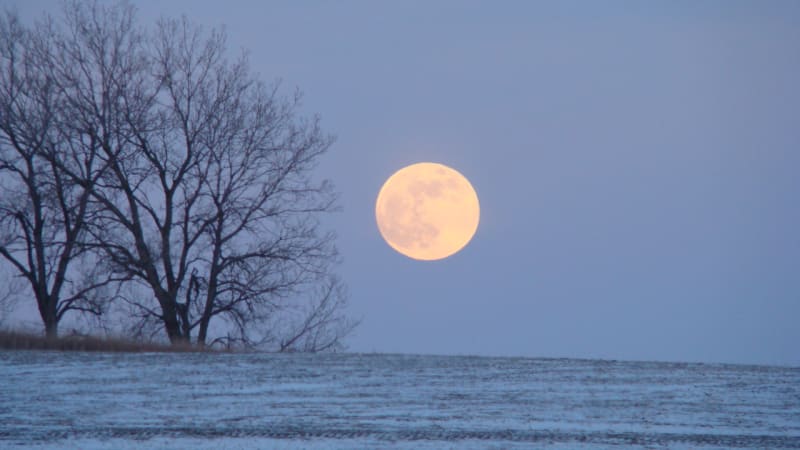
January's Wolf Supermoon: A Celestial Spectacle Illuminating Winter Skies
January's Wolf Supermoon offers a rare celestial display, rising at dusk with Jupiter and Pollux, connecting ancient folklore with modern astronomical wonder. This luminous event promises a spectacular view for stargazers across the Northern Hemisphere.
Stargazers and astronomy enthusiasts are in for a treat this weekend as the first full moon of 2026 prepares to grace the night sky, bringing with it a rich tapestry of cultural significance and astronomical wonder.
Known as the Wolf Moon, this celestial event will reach its peak at 5:02 a.m. EST on Saturday, January 3rd, offering a breathtaking display that connects modern observers with ancient traditions and natural cycles.
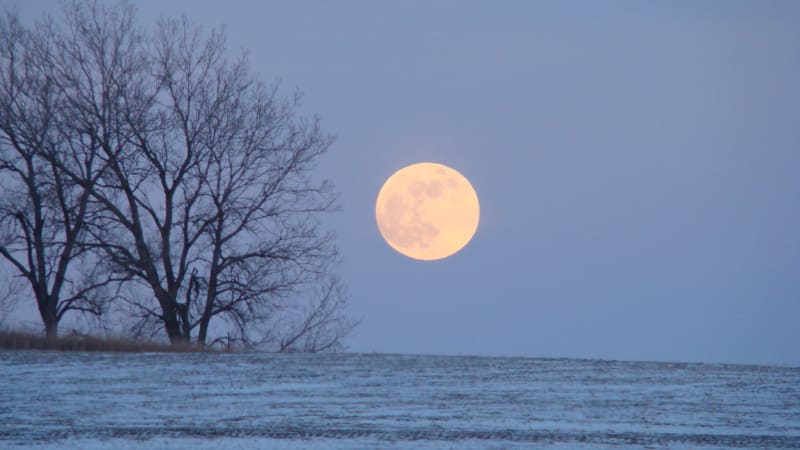
The moon's nickname stems from Native American folklore, where wolves were traditionally more vocal during this time of winter. Other indigenous names for this lunar event include the Cold Moon, Frost Exploding Moon, and Canada Goose Moon, each reflecting the unique environmental characteristics of midwinter.
Astronomically, this full moon is particularly special as it qualifies as a supermoon, appearing brighter and larger than typical lunar displays. It will rise in the eastern sky at dusk, positioned dramatically between Pollux, a brilliant star in the Gemini constellation, and Jupiter, which will be approaching its most luminous opposition of the year.
This Wolf Moon represents the fourth consecutive supermoon and will be positioned approximately 225,130 miles from Earth. Interestingly, its appearance coincides with Earth reaching perihelion - its closest point to the sun - at a distance of 91.4 million miles, compared to the average 93 million miles.
For Northern Hemisphere observers, the Wolf Moon will trace the highest arc through the night sky of any full moon, a result of its position relative to the winter solstice. European traditions also recognize this lunar event, often referring to it as the 'Moon After Yule', connecting it to ancient winter festivals.
Astronomy enthusiasts should mark their calendars, as this will be the last supermoon until November. The next full moon, the Snow Moon, will emerge on February 1st, continuing the celestial parade that captivates sky watchers around the world.
Based on reporting by Live Science
This story was written by BrightWire based on verified news reports.
Spread the positivity! 🌟
Share this good news with someone who needs it
More Good News
 🚀 Innovation
Stargazers' Delight: 15 Breathtaking Sky Spectacles Coming in 2026
 🚀 Innovation
Celestial Spectacle: A Stargazer's Guide to Planetary Displays in 2026
 🚀 Innovation