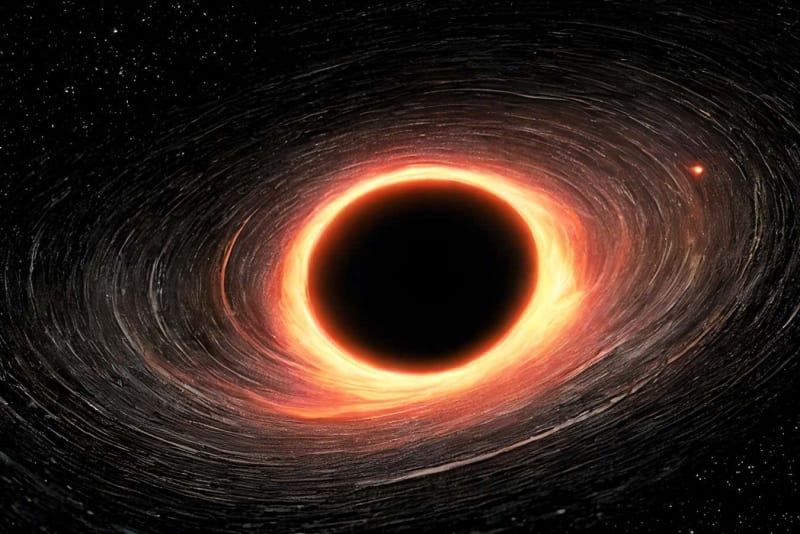
Massive Black Hole Discovery May Rewrite Cosmic Origin Story
Astronomers discover a massive black hole that may have formed differently than previously thought, potentially reshaping our understanding of cosmic evolution. The finding suggests primordial black holes could play a more significant role in universal structure than currently believed.
In a groundbreaking astronomical revelation, researchers have uncovered a mysterious black hole that could challenge our fundamental understanding of how cosmic structures emerge. Using the powerful James Webb Space Telescope, scientists spotted an enormous, star-sparse galaxy named Abell 2744-QSO1 that harbors a black hole approximately 50 million times the mass of our sun.
The discovery, led by Boyuan Liu from the University of Cambridge, presents a fascinating puzzle that defies traditional astrophysical theories. Typically, black holes form when massive stars collapse, but this particular cosmic entity appears to have emerged through an entirely different mechanism - potentially as a primordial black hole first theorized by legendary physicist Stephen Hawking.
Liu and his research team conducted sophisticated simulations exploring how these exotic cosmic objects might have formed shortly after the Big Bang. Their computational models suggest that instead of emerging from stellar collapse, this black hole could have coalesced from primordial density fluctuations in the universe's earliest moments.
The researchers' detailed simulations revealed intriguing insights into how these primordial black holes might interact with surrounding gas clouds and emerging stellar structures. Remarkably, their predictions about the black hole's mass and elemental composition aligned closely with their observational data from Abell 2744-QSO1.
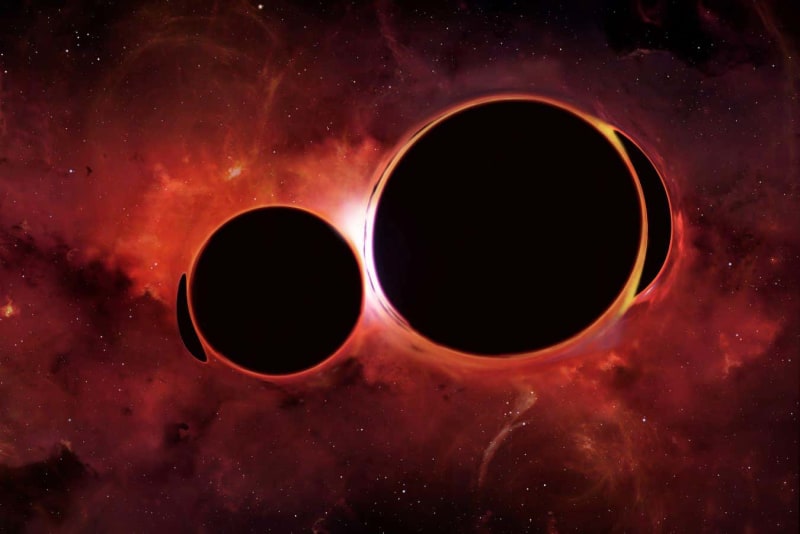
Roberto Maiolino, a team member from the University of Cambridge, noted the significance of these findings. While traditional models typically predict primordial black holes around 1 million solar masses, this discovery represents a black hole 50 times larger - suggesting potential merging mechanisms that could explain its exceptional size.
Despite the exciting potential, scientists remain cautious. The research team acknowledges that their findings are not conclusive and that more investigation is needed to fully understand this cosmic anomaly. The absence of high-energy radiation sources typically associated with black hole formation near QSO1 adds another layer of mystery to this extraordinary discovery.

This breakthrough not only challenges existing theories about black hole formation but also opens up thrilling new avenues for understanding the universe's earliest moments. As technology like the James Webb Space Telescope continues to push the boundaries of our cosmic knowledge, we stand on the precipice of rewriting fundamental chapters of our universal origin story.
Based on reporting by New Scientist
This story was written by BrightWire based on verified news reports.
Spread the positivity! 🌟
Share this good news with someone who needs it
More Good News
 🚀 Innovation
January's Night Sky: Jupiter and Its Four Massive Moons Offer Spectacular Stargazing Show
 🚀 Innovation
Bridging Science and Philosophy: Stephen Hawking's Quest to Understand Humanity's Future
 🚀 Innovation