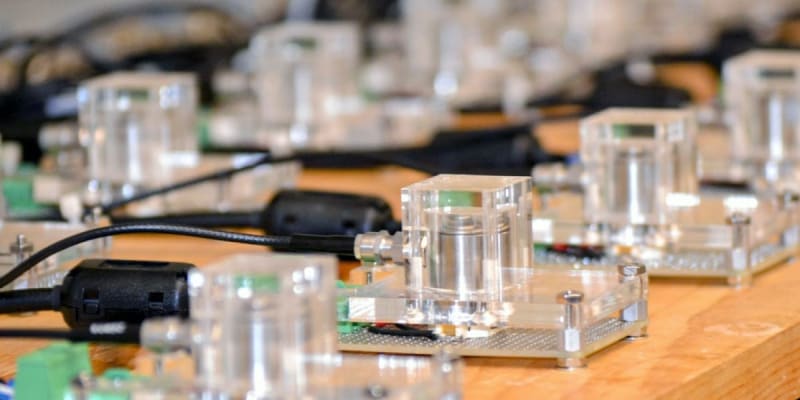
MIT Engineers Unlock Battery "Language" to Make Electric Vehicles Safer Than Ever
MIT researchers have made a breakthrough in battery safety by learning to interpret the subtle sounds batteries make, creating a path toward safer electric vehicles and energy storage systems. This innovative, passive monitoring technology could prevent battery failures before they happen, marking a significant leap forward in clean energy safety.
In an exciting development for clean energy technology, engineers at MIT have discovered how to "listen" to batteries and understand what they're saying—a breakthrough that promises to make electric vehicles and renewable energy storage safer and more reliable than ever before.
Lithium-ion batteries, the powerhouses behind our electric vehicles and grid-scale energy storage, have always whispered secrets through faint acoustic emissions as they charge and discharge. Until now, these subtle sounds remained a mystery. But Professor Martin Z. Bazant and his team of chemical engineers have cracked the code, opening the door to a new era of battery safety monitoring.
"Through some careful scientific work, our team has managed to decode the acoustic emissions," explains Bazant, a professor of chemical engineering and mathematics at MIT. The breakthrough allows researchers to distinguish between different types of battery activity—from harmless gas bubbles to more concerning fractures in the battery material.
What makes this discovery particularly exciting is its practical potential. The technology could lead to simple, passive monitoring devices that continuously keep watch over battery health without interfering with normal operations. Imagine electric vehicles that can warn drivers about battery issues long before any problem occurs, or massive energy storage facilities that can predict and prevent failures before they happen.
The research team took a thorough, innovative approach to understanding battery acoustics. They combined traditional electrochemical testing with careful recordings of acoustic emissions, using advanced signal processing to connect specific sounds with battery conditions. To verify their findings, they examined the batteries under electron microscopes, confirming the relationship between sounds and physical changes within the battery cells.
In collaboration with researchers at Oak Ridge National Laboratory, the team made another crucial discovery: these acoustic emissions can provide early warning of dangerous gas buildup that could lead to thermal runaway—a serious condition that can result in battery fires. Bazant likens it to "seeing the first tiny bubbles in a pot of heated water, long before it boils." This early detection capability could be transformative for battery safety.
The implications of this research extend far beyond the laboratory. As electric vehicles become increasingly common and renewable energy storage grows more essential for our power grids, ensuring battery safety and longevity becomes ever more critical. This acoustic monitoring technology offers a non-invasive, continuous way to safeguard these systems.
The beauty of this approach lies in its simplicity and practicality. Unlike complex diagnostic systems that require batteries to be taken offline or subjected to intensive testing, acoustic monitoring can work passively and continuously in the background. This means batteries could essentially diagnose themselves, alerting operators to potential issues while continuing to function normally.
As we transition to cleaner energy sources and electric transportation, innovations like this acoustic monitoring system help address one of the key challenges facing battery technology: ensuring reliability and safety at scale. The MIT team's work represents another important step toward a sustainable energy future, where batteries are not only more powerful and efficient but also safer and more trustworthy than ever before.
Based on reporting by MIT Technology Review
This story was written by BrightWire based on verified news reports.
Spread the positivity! 🌟
Share this good news with someone who needs it
More Good News
 🚀 Innovation
Clean Energy Breakthrough: Fusion Power Plant Takes Major Step Toward Reality
 🚀 Innovation
SK On and Seoul National University Make Exciting Battery Breakthrough
 🚀 Innovation
Finnish Startup Makes EV Dream Come True with Revolutionary 5-Minute Charging Battery
Joke of the Day
Why did the librarian get kicked out of class?
Explore Categories
Quote of the Day
"Do not go where the path may lead, go instead where there is no path and leave a trail."
— Ralph Waldo Emerson