
NASA Engineers Build Flying Drone to Explore Saturn's Moon Titan in 2034
A dedicated team of engineers is crafting an incredible car-sized rotorcraft that will soar through the skies of Saturn's moon Titan, marking humanity's first flying exploration of another world. The groundbreaking Dragonfly mission represents years of collaboration, precision craftsmanship, and scientific ambition coming together to unlock the mysteries of our solar system.
In laboratories across the United States, engineers are bringing to life one of the most ambitious space missions ever conceived. NASA's Dragonfly rotorcraft, a car-sized drone destined for Saturn's moon Titan, is taking shape at the Johns Hopkins Applied Physics Laboratory in Maryland, with teams working tirelessly to ensure this historic mission succeeds.
Set to launch in 2028 and arrive at Titan in 2034, Dragonfly represents a beautiful marriage of human ingenuity and scientific curiosity. The mission will take advantage of Titan's thick atmosphere and gentle gravity to fly between dozens of locations, exploring everything from organic sand dunes to impact craters where the building blocks of life may once have existed.
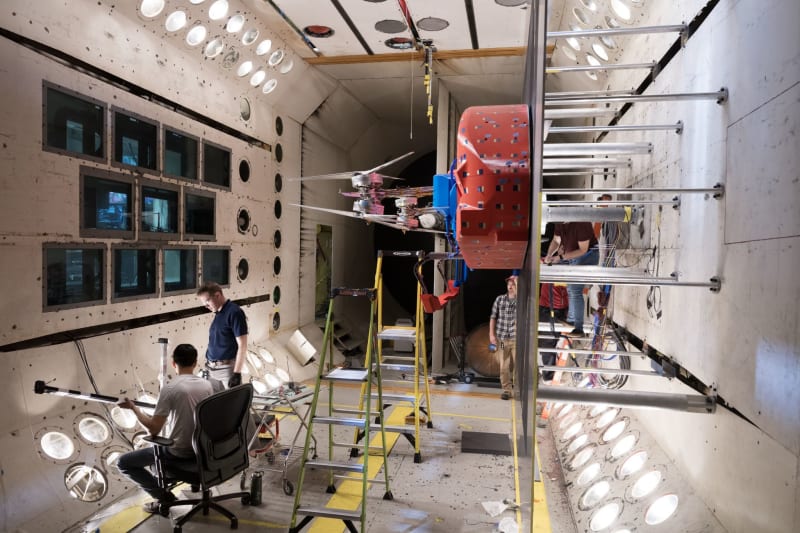
The path to this extraordinary achievement has been paved by countless hours of dedication and teamwork. Over five weeks last summer, engineers tested Dragonfly's full-scale rotors at NASA's Transonic Dynamics Tunnel in Hampton, Virginia. The facility, a 16-foot testing chamber that has served everyone from NASA to universities, provided the perfect environment to simulate Titan's unique conditions.
For experimental machinist Cory Pennington at APL, creating Dragonfly's rotors marked a career highlight. Starting with 1,000-pound aluminum blocks, Pennington and his team crafted these critical components with extraordinary precision. The pressure was real, as there was no room for practice runs or backup parts. Every cut had to be perfect the first time.
"We're not just cutting metal, we're fabricating something that's going to another world," Pennington said, his pride evident. "It's incredible to know that what we build will fly on Titan." The team's dedication paid off beautifully, delivering the finished rotors a full month ahead of schedule.
The rotors passed their rigorous tests with flying colors. The successful trials validated the design team's approach and provided invaluable data that will help engineers predict how Dragonfly will perform in Titan's alien environment. Lead rotor engineer Felipe Ruiz emphasized the complexity of the achievement, noting that the team is preparing for a flight environment scientists are still working to fully understand.
The Ripple Effect: This mission represents far more than a single achievement. Elizabeth "Zibi" Turtle, Dragonfly's principal investigator, highlights how the project demonstrates the power of collaboration across government and industry. Teams worked together under intense time pressure, developing innovative solutions and pushing the boundaries of what's possible.
The work continues as the rotors prepare for additional tests in conditions mimicking Titan's frigid minus 290 degrees Fahrenheit environment. But the progress already made shows what humanity can accomplish when brilliant minds unite around a common goal.
Dave Piatak, branch chief for aeroelasticity at NASA Langley, underscored the stakes and the team's readiness. "When Dragonfly enters the atmosphere at Titan, the rotors are going to have to work perfectly the first time," he said. Thanks to meticulous ground testing, the team is building the confidence needed for success.
As 2028 approaches, the world will witness the launch of a mission that embodies humanity's endless curiosity and determination to explore the unknown. Dragonfly isn't just a technological marvel. It's a testament to what we can achieve together.
More Images


Based on reporting by NASA
This story was written by BrightWire based on verified news reports.
Spread the positivity! 🌟
Share this good news with someone who needs it
More Good News
 Innovation
Chile Observatory Finds Fastest-Spinning Asteroid at 1.88 Minutes Per Rotation
 Innovation
Colorado Aerospace Firms to Lead $105M NASA Search for Extraterrestrial Life
 Innovation
James Webb Telescope Discovers Cosmic "Platypuses" That May Reveal Galaxy Birth Secrets
DAILY MORALE
What did the thermometer say to the graduated cylinder?
EXPLORE INTEL
DAILY INSPIRATION
Hope is the thing with feathers that perches in the soul and sings the tune without the words and never stops at all.
Emily Dickinson