NASA's Artemis II Moon Mission Launches This February
For the first time in over 50 years, humans are heading back to the moon. Four astronauts will journey farther from Earth than anyone in history this February.
After more than half a century, humanity is finally returning to the moon, and the countdown has officially begun.
NASA announced this Friday that Artemis II, carrying four astronauts on a historic 10-day journey around the moon, is nearly ready for liftoff. The launch window opens February 6, marking the first crewed lunar mission since the Apollo program ended in 1972.
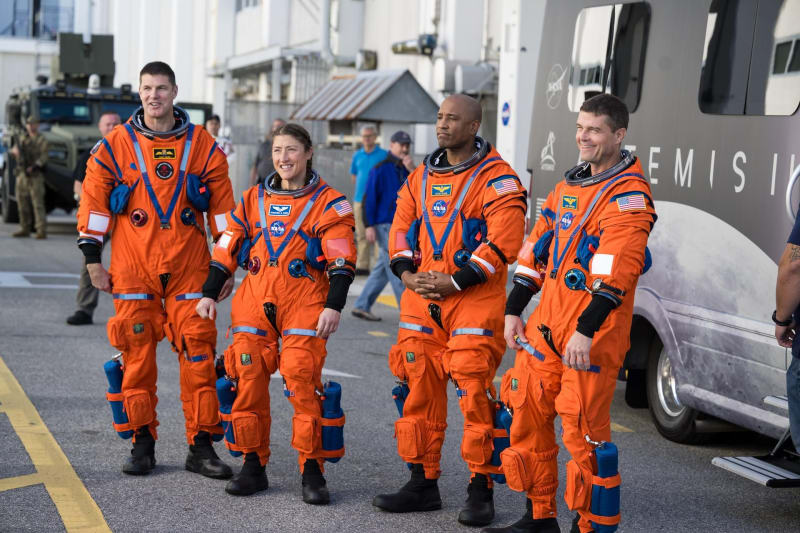
The crew includes NASA astronauts Reid Wiseman, Victor Glover, Christina Koch, and Canadian Space Agency astronaut Jeremy Hansen. They'll travel farther from Earth than any humans ever have, reaching 4,700 miles beyond the moon's far side.
Engineers at Kennedy Space Center in Cape Canaveral, Florida, began rolling out the fully stacked Space Launch System rocket on Saturday. The massive vehicle will crawl four miles over 12 days to reach Launch Pad 39B, where critical tests await.
The mission follows a free-return trajectory that uses the moon's gravity to loop the crew around and back toward Earth. During the flight, the astronauts will spend about a day observing the lunar surface, including parts of the moon's far side that have never been seen by human eyes.
"It's possible they'll see parts of the moon that have never been viewed by human eyes," said Jacob Bleacher, NASA's chief exploration scientist. He describes Artemis II as true exploration, where every system will be tested in the unforgiving environment of deep space.
The crew will wear sensors to monitor how their bodies respond beyond Earth's protective embrace. They're also carrying AVATAR, a system designed to mimic human organs, which will fly farther from Earth than ever before.
Why This Inspires
This mission represents more than technological achievement. It's about proving humans can survive and thrive in deep space again.
The astronauts will conduct what Bleacher calls "the science of us," learning how to protect future explorers who will actually land on the lunar surface. Every data point collected during these 10 days will help ensure the safety of the astronauts who follow.
Lead flight director Jeff Radigan acknowledges the uncertainty inherent in exploration. "This is a test flight, and there's things that are going to be unexpected," he said. "I think we've prepared for those as much as we can."
The mission faces real challenges, including concerns about the Orion capsule's heat shield after unexpected issues during the uncrewed Artemis I test. NASA adjusted the reentry plan to ensure crew safety during the fiery return through Earth's atmosphere.
After splashdown off the coast of San Diego, California, the crew's work continues. They'll complete obstacle courses and simulated space walks in their pressurized suits to test how the equipment performs after experiencing the extremes of space.
Mission management team chair John Honeycutt summed up the team's approach simply: "We're going to fly when we're ready."
The wait is almost over. Humanity's next giant leap is just weeks away.
More Images


Based on reporting by Scientific American
This story was written by BrightWire based on verified news reports.
Spread the positivity! 🌟
Share this good news with someone who needs it