New Tool Helps Cold Regions Plan Cleaner EV Charging
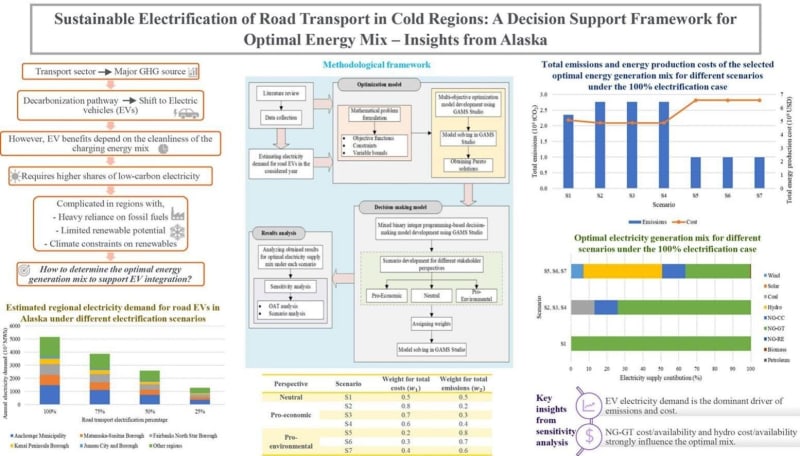
Researchers at UBC developed a planning framework that helps cold-weather regions balance cost and emissions when powering electric vehicle chargers. Their Alaska study found a balanced approach cuts emissions 15% while costing 22% less than the cleanest option.
Electric vehicles promise cleaner transportation, but a new study shows that making them truly green in cold climates requires rethinking the entire power grid behind the plug.
Sandali Walgama, a doctoral student at UBC Okanagan, led research that gives policymakers a practical tool for planning electricity generation as EV adoption grows. Her team used Alaska as a test case, modeling how the state could meet rising charging demand using its mix of natural gas, coal, hydro, wind, and solar power.
The findings reveal a common climate dilemma: the cheapest path forward relies heavily on coal and natural gas, while the cleanest option depends on renewable sources that face real limitations in harsh winter conditions. Neither extreme makes practical sense.
The research team discovered a middle ground. A balanced strategy reduced emissions by 15% compared to the cheapest approach while costing 22% less than going all-in on the lowest-emissions route.
"EVs are often framed as a simple swap from gas to electric," says Walgama. "In reality, cold regions face constraints that make planning the power mix just as important as deploying chargers."
The framework pairs two decision-making tools that work together. One shows the best cost-emissions trade-offs available, while the other helps leaders choose an option that fits their specific priorities, whether that's minimizing costs, cutting emissions, or finding balance.
The study also highlights how unpredictable factors like EV adoption rates and natural gas prices can dramatically shift what the "best" solution looks like. The researchers recommend stress-testing strategies against multiple scenarios before committing.
Professor Kasun Hewage, who co-authored the study, emphasizes the tool's flexibility. "It helps jurisdictions identify solutions which are environmentally, socially and economically viable and remain sensible even as demand forecasts and energy prices shift," he says.
The Ripple Effect: This framework extends beyond Alaska. Cold-weather regions from Canada to Scandinavia face similar challenges as they electrify transportation. By making trade-offs transparent and testable, the tool helps communities avoid investing in charging infrastructure powered by grids that don't deliver the climate benefits EVs promise. It turns the transition to electric vehicles into an opportunity to rethink energy systems altogether.
As more northern communities commit to electric transportation, they now have a roadmap that works with their climate instead of against it.
More Images



Based on reporting by Phys.org - Technology
This story was written by BrightWire based on verified news reports.
Spread the positivity! 🌟
Share this good news with someone who needs it
_1.png)

