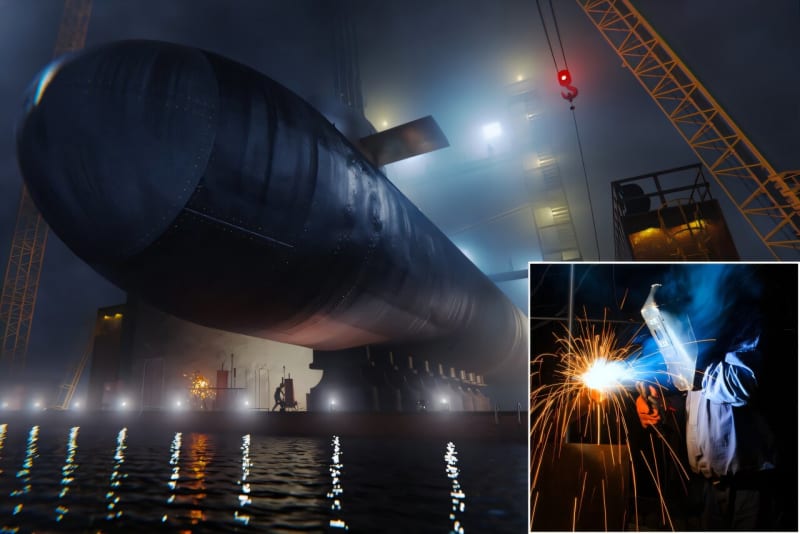
Oak Ridge Scientists Use Neutrons to Keep Submarine Crews Safe at Sea
Brilliant researchers at Oak Ridge National Laboratory are pioneering neutron technology to protect the brave crews aboard U.S. Navy submarines. Their groundbreaking work is helping prevent dangerous cracks in submarine hulls, ensuring safer vessels for the sailors who defend our nation hundreds of feet below the ocean's surface.
Deep beneath the ocean's surface, where sunlight never reaches and pressure can crush the unprepared, the crews of America's nuclear submarines carry out their vital missions. Now, thanks to innovative scientists at Oak Ridge National Laboratory, these brave sailors are getting an extra layer of protection through cutting-edge neutron research that's making their vessels even safer.
The research team, led by University of Connecticut Professor Lesley Frame in collaboration with the U.S. Navy and Electric Boat, is tackling a persistent challenge in submarine construction. They're using advanced neutron scattering technology to understand and prevent tiny cracks that can form in the welded seams of submarine hulls. These submarines operate more than 800 feet below the surface, where water pressure exceeds 50,000 pounds per square foot, making the integrity of every welded joint absolutely critical.
What makes this research particularly exciting is the innovative approach the team is taking. Using the High Intensity Diffractometer for Residual Stress Analysis at Oak Ridge's High Flux Isotope Reactor, they can peer deep inside thick metal welds without cutting them apart. The neutrons act like invisible detectives, revealing internal stresses and potential weak points that could compromise safety.
"We're trying to nondestructively map out the stresses in the welded material," Frame explains with enthusiasm. "We don't need to cut up the sample, which is one of the big benefits of working with neutrons." Even better, the process is remarkably efficient, taking just hours instead of weeks to gather crucial data.
Doctoral student Matt Caruso, a key member of the research team, is helping develop computer models that will predict exactly when welding conditions might cause problems. This forward-thinking approach means submarine builders can prevent issues before they ever occur, rather than simply reacting to problems after the fact.
The team is studying a specialized alloy made of 70 percent copper and 30 percent nickel, widely used in naval applications worldwide. By understanding how heat from welding creates internal stresses in this material, they're developing solutions that will benefit not just U.S. submarines but naval vessels around the globe.
The Ripple Effect
This research represents more than just technical achievement. It's about protecting the men and women who volunteer to serve their country in one of the most demanding environments on Earth. Every improvement in hull integrity means greater peace of mind for submarine crews and their families back home.
The collaboration between Oak Ridge National Laboratory, the University of Connecticut, the Navy, and Electric Boat showcases how partnerships between academic institutions, government agencies, and industry can solve real-world challenges. The team is even complementing their neutron work with X-ray testing at Brookhaven National Laboratory, using multiple cutting-edge techniques to get the complete picture.
As Caruso optimistically notes, "Our research will increase our understanding of ductility dip cracking and offer approaches to help mitigate its occurrence. Preventing DDC cracking will result in safer vessels for the Navy." That's a goal everyone can celebrate: applying scientific innovation to protect those who protect us, one neutron beam at a time.
More Images

Based on reporting by Phys.org - Technology
This story was written by BrightWire based on verified news reports.
Spread the positivity! 🌟
Share this good news with someone who needs it
More Good News


DAILY MORALE
What did the thermometer say to the graduated cylinder?
EXPLORE INTEL
DAILY INSPIRATION
Hope is the thing with feathers that perches in the soul and sings the tune without the words and never stops at all.
Emily Dickinson