Rajasthan Community Leaders Listen, Retract Smartphone Ban After Women Speak Up
In a heartening turn of events, community leaders in Jalore, Rajasthan, quickly reversed a restrictive smartphone policy after widespread backlash and intervention by the National Human Rights Commission. The swift response demonstrates the power of public accountability and women's voices in driving positive change.
Sometimes the most inspiring stories aren't about perfect situations, but about communities learning, growing, and choosing to do better. That's exactly what happened in Jalore, Rajasthan, where community leaders demonstrated their willingness to listen and adapt after initially making a controversial decision about women's smartphone use.
When the Chaudhury caste panchayat in Jalore initially announced restrictions on women using smartphones, the decision quickly drew attention from across India and beyond. Within just four days, on December 25, the leaders took the remarkable step of retracting their order entirely, showing a responsiveness that speaks to the power of public discourse and accountability in modern India.
The swift reversal came after multiple forces worked together for positive change. The National Human Rights Commission took immediate action, issuing a notice to the District Magistrate of Jalore and demanding a full investigation. Pradeep Gawande, Deputy Magistrate, wasted no time sending a team to engage with the community, facilitating dialogue that led to the retraction.
What makes this story particularly meaningful is how it highlights the growing strength of institutional oversight and public awareness in protecting individual freedoms. The incident demonstrates that even in traditional communities, there are mechanisms for course correction when decisions overstep boundaries.
The backdrop to this story reveals broader challenges worth addressing. In rural India, mobile phone ownership shows a significant gender gap, with 80.7% of men owning phones compared to just 48.4% of women, according to India's Comprehensive Modular Survey, Telecom 2025. This makes access to technology an important equity issue.
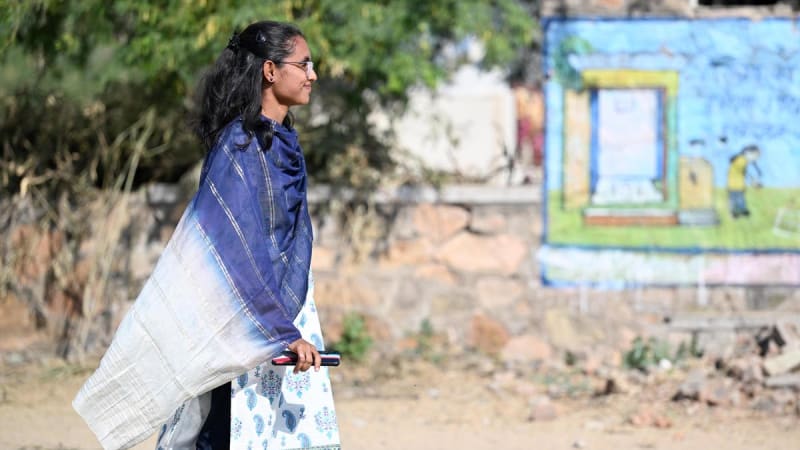
Young women like 19-year-old Deshu Chaudhury represent the changing face of rural Rajasthan. As a teacher pursuing her Basic School Teaching certificate from Rajasthan University, she relies on her smartphone to connect with tuition centres nearly two hours away, enabling her to continue her education despite geographical barriers. Her determination to learn and grow professionally showcases the aspirations of countless young women in similar situations.
The Bright Side: This incident, while initially concerning, ultimately tells an encouraging story about India's evolving social landscape. The rapid response from human rights organizations, government officials, and the global community created immediate accountability. Within days, dialogue replaced decree, and community leaders acknowledged their misstep.
The involvement of activists like Manish Jain, who filed the complaint with the NHRC through his non-profit, demonstrates how civil society organizations serve as vital bridges between communities and institutional protections. The media's attention to the issue and the viral spread of information on social media platforms proved that transparency and public awareness are powerful tools for positive change.
Most importantly, this story shows that change is possible. When community leaders face criticism, they have a choice: to dig in or to listen. The Chaudhury panchayat chose to listen, setting a precedent that could encourage other communities to engage in more inclusive decision-making processes.
As India continues its journey toward greater gender equality and digital inclusion, stories like this remind us that progress isn't always linear, but the mechanisms for correction are growing stronger every day.
Based on reporting by The Hindu
This story was written by BrightWire based on verified news reports.
Spread the positivity! 🌟
Share this good news with someone who needs it
More Good News
 Solutions
Pune Congress Promises Free Bus Travel for Women, Major City Upgrades
 Solutions
Senegal's Inspiring 'School of Husbands' Empowers Men to Champion Gender Equality
 Solutions
Chennai Takes Bold Steps to Make City Safer and More Inclusive for All Women
DAILY MORALE
Why did the dog apply for a job at the bank?
EXPLORE INTEL
MISSION DIRECTIVE
The greatest thing you'll ever learn is just to love and be loved in return.
Moulin Rouge (from the film, popularized by Ewan McGregor)