Revolutionary 3D Printing Breakthrough Paves Way for Lightning-Fast Computing Future
Scientists in South Korea have achieved a remarkable breakthrough in nanolaser technology, developing a revolutionary 3D printing method that could transform everything from artificial intelligence computing to quantum security. This exciting innovation brings us closer to a future of ultra-fast optical computers and next-generation display technology.
In an inspiring leap forward for technology, researchers at the Korea Advanced Institute of Science and Technology (KAIST) have unveiled a groundbreaking method to create tiny lasers that could revolutionize how our computers process information and keep our data secure.
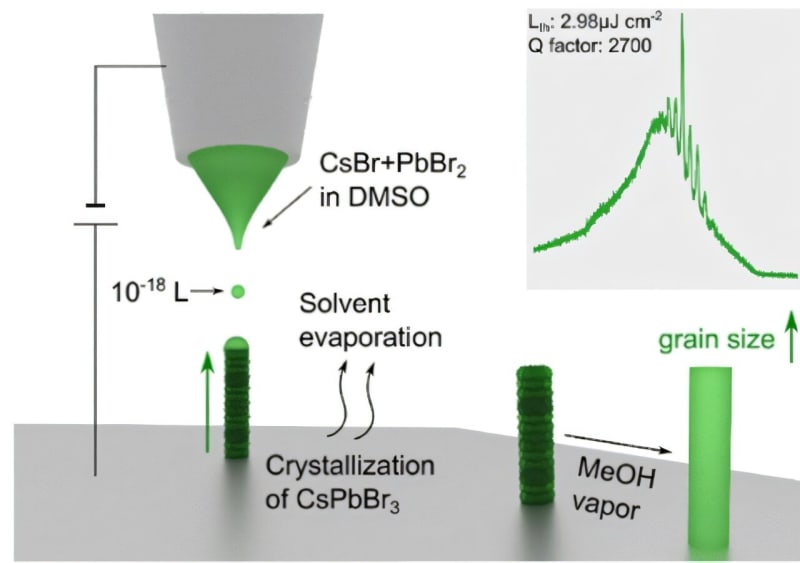
The team, led by Professor Ji Tae Kim and Professor Junsuk Rho from POSTECH, has developed an innovative 3D printing technique that creates "vertical nanolasers"—incredibly small light-based components thinner than a human hair. This achievement, published in the prestigious journal ACS Nano, represents a significant milestone in semiconductor technology with far-reaching positive implications.
What makes this discovery so exciting is how it solves longstanding challenges in semiconductor manufacturing. Traditional methods are complex, expensive, and inflexible, limiting innovation. The new approach uses what scientists call "ultra-fine electrohydrodynamic 3D printing," which sounds complicated but delivers beautifully simple results: the ability to precisely place these tiny lasers exactly where needed on a chip, without wasteful carving or complex processing steps.
The secret ingredient is perovskite, a next-generation semiconductor material that generates light with remarkable efficiency. By printing this material vertically in pillar-shaped structures, the team has created nanolasers that work far more efficiently than traditional horizontal designs. The vertical orientation means less wasted space and minimal light loss—a win-win for performance and sustainability.
One of the most elegant aspects of this technology is the exceptional smoothness of the printed structures. By combining advanced printing with gas-phase crystallization control, the researchers achieved nearly perfect single-crystalline alignment, resulting in high-quality, stable nanolasers that operate with minimal energy loss.
The applications are wonderfully diverse and practical. For artificial intelligence systems that require massive computing power, these nanolasers could enable ultra-high-speed optical computing that processes information using light instead of electricity. For augmented reality enthusiasts, this technology promises ultra-high-resolution displays. And for anyone concerned about security, the team has demonstrated an ingenious application: creating invisible laser security patterns that can only be detected with specialized equipment, opening doors for sophisticated anti-counterfeiting measures.
Perhaps most impressively, the researchers discovered they could fine-tune the color of the laser light simply by adjusting the height of the nanostructures—a feature that adds remarkable versatility to the technology's potential applications.
"This technology allows for the direct, high-density implementation of optical computing semiconductors on a chip without complex processing," Professor Kim explained enthusiastically. "It will accelerate the commercialization of ultra-high-speed optical computing and next-generation security technologies."
This breakthrough represents more than just a technical achievement—it's a glimpse into a future where our devices are faster, more efficient, and more secure. As we navigate an increasingly digital world demanding ever-greater computing power for everything from climate modeling to medical research, innovations like this remind us that human ingenuity continues to rise to meet our challenges.
The successful peer-reviewed publication of this research confirms its scientific rigor, and the team's demonstration of practical applications suggests we may see real-world benefits sooner than we might expect. It's an encouraging reminder that scientific progress continues to open new possibilities for a brighter technological future.
Based on reporting by Phys.org
This story was written by BrightWire based on verified news reports.
Spread the positivity! 🌟
Share this good news with someone who needs it
More Good News


DAILY MORALE
What did the thermometer say to the graduated cylinder?
EXPLORE INTEL
DAILY INSPIRATION
Hope is the thing with feathers that perches in the soul and sings the tune without the words and never stops at all.
Emily Dickinson