Revolutionary AI Imaging Brings New Hope to Thyroid Cancer Surgery
Scientists have developed an exciting new technology that combines artificial intelligence with light-based imaging to help surgeons identify thyroid cancer during operations with remarkable accuracy. This breakthrough could spare patients from unnecessary procedures while ensuring more precise cancer removal, marking a significant leap forward in personalized cancer care.
In a development that's bringing fresh optimism to cancer treatment, researchers have unveiled a groundbreaking technology that could transform how thyroid cancer surgery is performed—and it's showing tremendous promise for patients everywhere.
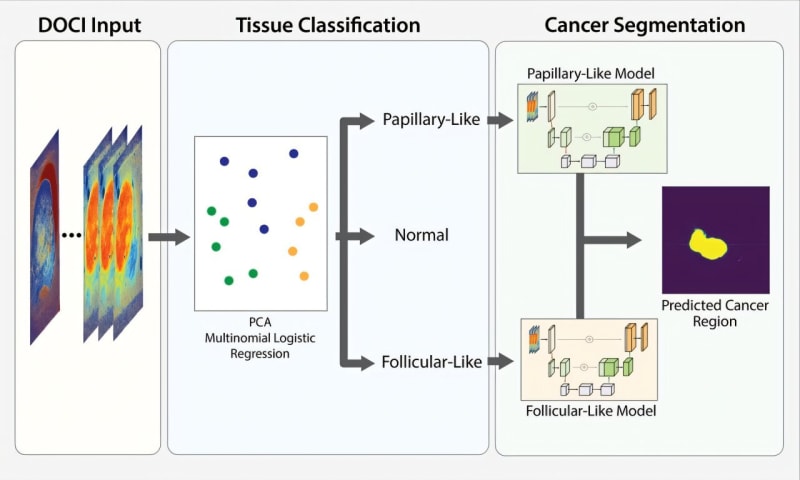
The innovative approach combines Dynamic Optical Contrast Imaging (DOCI) with artificial intelligence to give surgeons an unprecedented view of cancer during operations. What makes this particularly exciting is that the technology works by reading the natural "glow" of tissue, requiring no dyes or contrast agents whatsoever. It's a beautifully elegant solution that harnesses nature's own signals to distinguish healthy tissue from cancerous cells.
Here's how this remarkable technology works: every tissue in our body emits a faint natural light called autofluorescence. Healthy and cancerous tissues glow differently, creating unique optical signatures. DOCI captures these signals across 23 different optical channels, creating a detailed spectral fingerprint that reveals the tissue's biological story.
The research team, led by Tyler Vasse at Duke University in collaboration with colleagues at UCLA, developed a sophisticated two-stage AI system that translates these optical signals into practical surgical guidance. In the first stage, the system accurately classifies tissue samples—achieving perfect accuracy on test samples in distinguishing healthy thyroid tissue from the two most common types of thyroid cancer. Even more encouraging, it successfully identified the highly aggressive anaplastic subtype as cancerous, demonstrating its broad sensitivity.
The second stage answers the crucial question every surgeon faces: exactly where is the tumor? Using advanced deep-learning models, the system generates precise tumor probability maps, highlighting cancerous regions with exceptional accuracy, particularly for papillary thyroid cancer, while maintaining remarkably low false-positive rates.
This breakthrough comes at an important time. Thyroid cancer is the most common endocrine cancer, with detection rates continuing to rise. Currently, surgeons face significant challenges during tumor removal, often struggling to determine exactly how much tissue to remove while protecting delicate nearby structures. Traditional diagnostic methods, while accurate, are time-consuming and offer no real-time guidance during surgery. This can lead to patients undergoing unnecessary surgery for benign nodules or requiring additional procedures if cancerous tissue is initially missed.
The beauty of this new technology lies in its potential to change all that. By merging the speed of optical imaging with the power of AI, DOCI could soon provide surgeons with rapid, label-free guidance right in the operating room. This means reduced uncertainty during surgery, fewer unnecessary procedures, better preservation of healthy tissue, and ultimately, improved outcomes for patients.
While this research analyzed tissue immediately after removal, the results illuminate a promising path forward. The study, published in Biophotonics Discovery, represents a collaborative triumph involving multi-institutional expertise and cutting-edge technology working in harmony.
For the countless individuals diagnosed with thyroid cancer each year, this development offers genuine hope: a future where surgical precision is enhanced, recovery is optimized, and treatment is more personalized than ever before. It's a powerful reminder of how innovation continues to brighten the landscape of cancer care, helping surgeons see cancer in—quite literally—a whole new light.
Based on reporting by Medical Xpress
This story was written by BrightWire based on verified news reports.
Spread the positivity! 🌟
Share this good news with someone who needs it
More Good News
 🚀 Innovation
AI Teams Up With Rescue Dogs to Save Lives 10 Times Faster—A Perfect Partnership
 🚀 Innovation
JinkoSolar's AI-Powered Partnership Heralds Exciting Solar Energy Breakthrough
 🚀 Innovation
Arm Holdings Launches Exciting New Robotics Division to Shape Future of AI
Joke of the Day
Why don't scientists trust atoms?
Explore Categories
Quote of the Day
"The only way to do great work is to love what you do."
— Steve Jobs