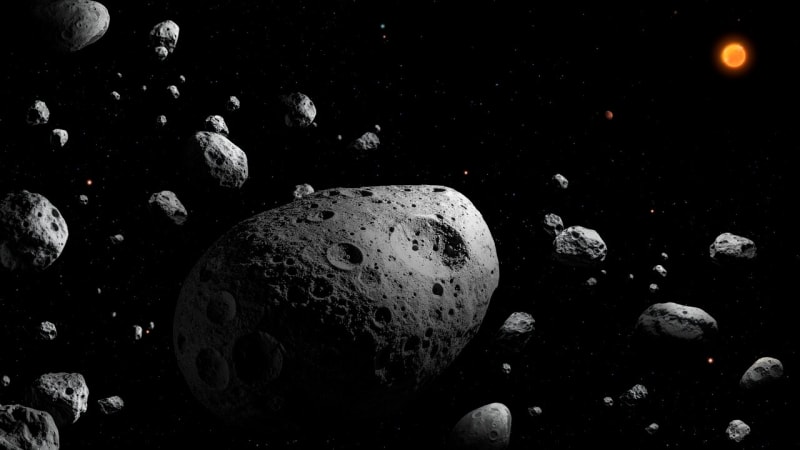
Revolutionary Telescope Discovers Record-Breaking Spinning Asteroid in Breakthrough Achievement
The magnificent Vera C. Rubin Observatory has made astronomical history by spotting the fastest-spinning large asteroid ever recorded, rotating once every 1.88 minutes! This thrilling discovery showcases humanity's growing ability to unlock the secrets of our Solar System and demonstrates the incredible potential of cutting-edge space technology.
In an exciting glimpse of what's to come, astronomers working with the groundbreaking Vera C. Rubin Observatory have discovered an extraordinary cosmic wonder: the fastest-spinning asteroid larger than half a kilometer ever found. This remarkable space rock, designated 2025 MN45, completes a full rotation every 1.88 minutes—a stunning feat that's rewriting our understanding of what's possible in our Solar System.
The discovery represents a triumphant collaboration between the U.S. National Science Foundation and the U.S. Department of Energy's Office of Science, demonstrating the power of scientific partnership. Led by Sarah Greenstreet, an assistant astronomer at NSF NOIRLab, the research team identified 19 ultra-fast and super-fast rotating asteroids, with their findings published in The Astrophysical Journal Letters.
What makes this discovery particularly thrilling is that it came from just ten hours of observation across seven nights in spring 2025—and this was during the observatory's early testing phase! Once the full Legacy Survey of Space and Time begins in the coming months, astronomers expect an avalanche of new discoveries that will transform our understanding of the universe.
The record-breaking asteroid measures 710 meters in diameter—roughly the size of eight football fields—and its incredible rotation speed reveals fascinating insights about its composition. To spin so rapidly without breaking apart, 2025 MN45 must be made of remarkably strong material, similar to solid rock. This challenges previous assumptions that most asteroids are simply "rubble piles" of loose debris held together by gravity.
"Rubin Observatory will find things that no one even knew to look for," enthuses Luca Rizzi, an NSF program director, capturing the sense of wonder surrounding this technological marvel. The observatory's incredible LSST Camera—the largest digital camera in the world—can capture images every 40 seconds, enabling discoveries that were previously impossible.
During their observations, the team identified thousands of asteroids, including approximately 1,900 that had never been seen before. Among these, they found 76 asteroids with reliable rotation periods, including 16 super-fast rotators and three ultra-fast rotators completing full spins in less than five minutes.
These spinning space rocks aren't just fascinating curiosities—they're time capsules that tell the story of our Solar System's formation billions of years ago. Fast rotation rates can indicate past collisions, suggesting these asteroids might be fragments of larger objects. Understanding their composition and behavior helps scientists piece together the dynamic history of our cosmic neighborhood.
"The ability to find thousands of new asteroids in such a short period of time, and learn so much about them, is a window into what will be uncovered during the 10-year survey," says Aaron Roodman, Deputy Head of LSST and professor at SLAC National Accelerator Laboratory.
As the Vera C. Rubin Observatory prepares to begin its full mission—repeatedly scanning the Southern Hemisphere night sky for ten years—this early success offers a tantalizing preview of the discoveries ahead. Each night will bring new revelations, expanding humanity's knowledge and inspiring future generations to look up in wonder at the cosmic dance happening all around us.
Based on reporting by Reddit - Space
This story was written by BrightWire based on verified news reports.
Spread the positivity! 🌟
Share this good news with someone who needs it
More Good News
 🚀 Innovation
Philanthropists Fund Hubble-Beating Space Telescope in Just 3 Years for Fraction of Cost
 🚀 Innovation
Schmidt Sciences Unveils Lazuli: Private Space Telescope Larger Than Hubble
 🚀 Innovation
NASA's Roman Space Telescope: A Triumph of Science, On Time and Under Budget
Joke of the Day
Why did the dog apply for a job at the bank?
Explore Categories
Quote of the Day
"The greatest thing you'll ever learn is just to love and be loved in return."
— Moulin Rouge (from the film, popularized by Ewan McGregor)