Revolutionary Touch-Free Tech Detects Lung Disease with 98% Accuracy—No Contact Needed
Scientists have developed an incredible wireless monitoring system that can accurately detect five common lung diseases without any physical contact, using radio waves and AI. This breakthrough could transform healthcare, making diagnosis safer, faster, and more accessible for millions worldwide.
Imagine being screened for serious lung conditions without needles, X-rays, or even a stethoscope touching your chest. Thanks to groundbreaking research from scientists in Scotland and Pakistan, that future is now closer than ever.
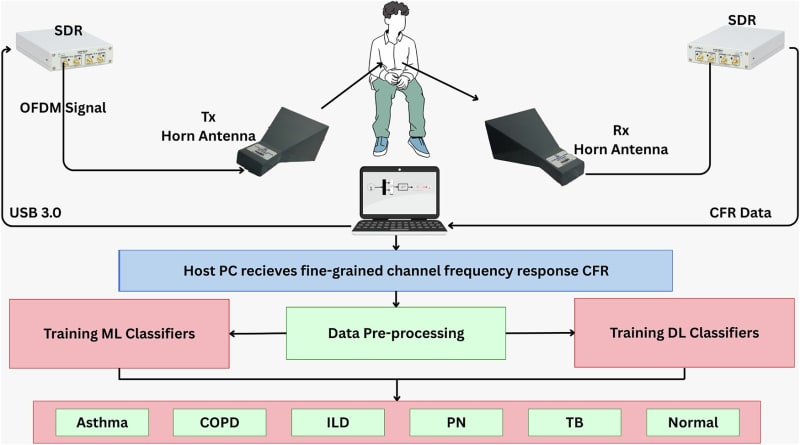
An international team of engineers and computing scientists has developed a remarkable wireless sensing system that can detect five common pulmonary diseases with an astonishing 98% accuracy—all without any physical contact with patients. This innovative technology represents a significant leap forward in personalized health monitoring and could revolutionize how we approach medical diagnostics in both hospitals and homes.
The system works by using harmless radio waves at frequencies similar to those that will power future 6G and WiFi7 networks. These gentle microwave signals bounce off patients' chests, and sophisticated artificial intelligence analyzes the reflected patterns to identify breathing signatures unique to different lung conditions. The technology can successfully screen for asthma, chronic obstructive pulmonary disease, interstitial lung disease, pneumonia, and tuberculosis.
What makes this achievement even more impressive is how the team validated their innovation. They collected data from 190 patients with various respiratory conditions at a hospital in Lahore, Pakistan, along with 30 healthy individuals. After analyzing nearly seven and a half hours of data using multiple AI models, they found that their best-performing system could identify specific illnesses 98% of the time and recognize healthy individuals with perfect 100% accuracy.
Professor Qammer H. Abbasi from the University of Glasgow's Center for Integrated Sensing and Communication Enabling Cognitive Cities emphasizes the exciting potential ahead. "The ultrafast 6G wireless communications networks of the future will unlock a wide range of benefits for people around the world, with healthcare being one of the key applications," he explains. Remarkably, this sophisticated sensing only uses 12.5% of the system's bandwidth, meaning the remaining capacity could support continuous health monitoring while maintaining normal data transmission.
Professor Muhammad Mahboob Ur Rahman from Pakistan's Information Technology University highlights how this innovation could be life-changing, especially for underserved communities. "Being able to do accurate, low-cost, and swift mass screening of people for their respiratory health in a non-clinical setting could be a game-changer for healthcare delivery," he notes. The system eliminates the need for invasive spirometry tests or uncomfortable radiation from X-rays and CT scans.
The implications extend far beyond convenience. This touch-free approach could prove invaluable during disease outbreaks like COVID-19, where minimizing physical contact helps protect both patients and healthcare workers. Early detection through continuous, contactless monitoring could also reduce healthcare costs by enabling earlier medical intervention before conditions worsen.
As we look toward smart homes and integrated healthcare systems of the future, this research published in Communications Medicine demonstrates how emerging technologies can make medical care more accessible, comfortable, and effective for everyone. It's a beautiful example of innovation serving humanity's most fundamental need: the ability to stay healthy and thrive.
Based on reporting by Medical Xpress
This story was written by BrightWire based on verified news reports.
Spread the positivity! 🌟
Share this good news with someone who needs it
More Good News
 🚀 Innovation
Revolutionary AI Tool Promises Earlier Detection and Better Treatment for Metabolic Health
 🚀 Innovation
Revolutionary Soft Implants Bring New Hope for Deep-Tissue Health Monitoring
 🚀 Innovation
Global Medical Experts Unite to Create Groundbreaking AI Safety Framework for Healthcare
Joke of the Day
Why did the librarian get kicked out of class?
Explore Categories
Quote of the Day
"Do not go where the path may lead, go instead where there is no path and leave a trail."
— Ralph Waldo Emerson