Scientists Unlock Greener Future for Everyday Products with Breakthrough Catalyst Discovery
Researchers at Rice University have revealed how to make the production of vinyl acetate—found in adhesives, paints, and packaging—cleaner and more efficient. This exciting breakthrough could slash emissions, reduce waste, and make everyday materials more affordable and sustainable for everyone.
In a discovery that promises to make our everyday products greener and more sustainable, scientists at Rice University have unlocked the secrets of how industrial catalysts work during the manufacturing of vinyl acetate monomer (VAM). This might sound technical, but the implications are wonderfully practical: the adhesives holding our homes together, the paints brightening our walls, and the packaging protecting our food could all soon be produced more cleanly and efficiently.
"Vinyl acetate underpins a huge slice of the modern materials economy, so small efficiency gains can translate into major environmental and economic benefits," explains Michael Wong, the Tina and Sunit Patel Professor in Molecular Nanotechnology at Rice University, who led the groundbreaking study.
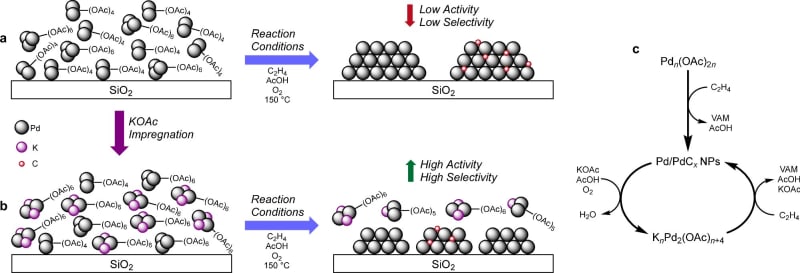
The research team, working alongside global industry leader Celanese Corp., Purdue University, and Oak Ridge National Laboratory, discovered how tiny molecular structures called palladium-acetate trimers and dimers behave during production. By understanding these molecular dancers, manufacturers can now design catalysts that use less energy, create less waste, and deliver more stable production over time.
Published in the prestigious journal Nature Communications, the study used cutting-edge X-ray technology, spectroscopy, and electron microscopy to watch these molecules in action under real-world conditions. What they found was thrilling: by fine-tuning these molecular species, manufacturers can dramatically improve how efficiently raw materials transform into useful products rather than being wasted as carbon dioxide.
"We found that by tuning these molecular species, you can dramatically change how the catalyst uses energy and how much valuable product you get for every molecule you put in," shares Hunter Jacobs, co-first author and Rice doctoral alumnus. "That's exactly the kind of insight that can help industry lower operating temperatures, cut emissions and stretch resources further."
Perhaps most exciting is that molecules once thought to be signs of catalyst failure turned out to be dynamic players in the production process. "These trimers and dimers were often treated as inactive species," explains co-first author Welman Curi-Elias. "Our results show they are dynamic players that control how efficiently and cleanly vinyl acetate is made."
The benefits of this discovery ripple outward in heartening ways. Manufacturers will be able to reduce energy consumption in large-scale production, meaning lower greenhouse gas emissions. Less material will be wasted, and industrial equipment will last longer thanks to more stable catalyst performance. For consumers, this means more reliable supplies and potentially more stable pricing for countless everyday products.
"Every gain in selectivity means less raw material burned off as carbon dioxide and more of it ending up in useful products," Wong emphasizes. "That's good for the climate, for manufacturers and for the people who rely on these materials every day."
For Celanese, which operates major VAM production facilities worldwide, the findings provide a clear pathway forward. "If we can produce the same amount of vinyl acetate using less energy with less waste and fewer shutdowns, that benefits our customers, our communities and the environment," says Kevin Fogash, senior director of process technology for Celanese.
This research represents the kind of scientific breakthrough that makes sustainable manufacturing not just possible, but practical—proving once again that innovation and environmental stewardship go hand in hand.
Based on reporting by Phys.org
This story was written by BrightWire based on verified news reports.
Spread the positivity! 🌟
Share this good news with someone who needs it
More Good News
 🚀 Innovation
Four Sisters Build Europe's First Electric Tractor, Win National Energy Award
 🚀 Innovation
South African Scientists Turn Pineapple Waste Into Crime-Fighting Powder
 🚀 Innovation
Scientists Create Revolutionary Color-Changing Skin Inspired by Ocean's Master of Disguise
Joke of the Day
Why did the dog apply for a job at the bank?
Explore Categories
Quote of the Day
"The greatest thing you'll ever learn is just to love and be loved in return."
— Moulin Rouge (from the film, popularized by Ewan McGregor)