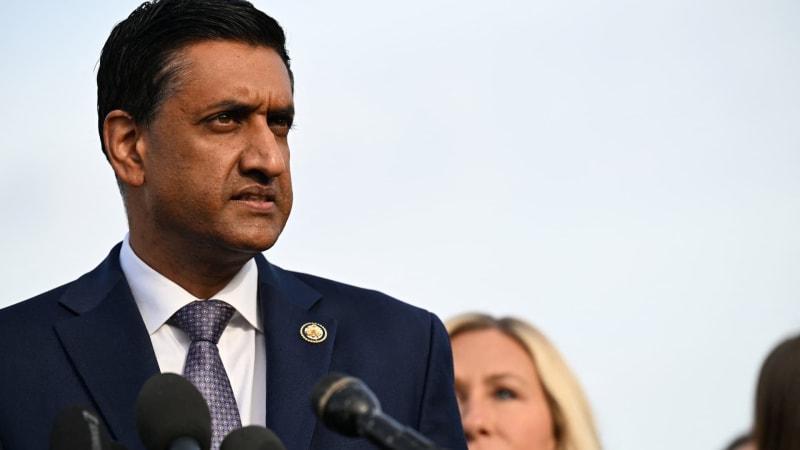
Silicon Valley Divided: Rep. Ro Khanna Stands Firm on Potential Billionaire Tax, Sparking Heated Debate
A proposed California billionaire tax has sparked intense debate between Representative Ro Khanna and Silicon Valley leaders. The measure could reshape discussions about wealth taxation and tech industry economic contributions.
A potential statewide tax on California billionaires has ignited a firestorm of controversy, pitting Democratic Representative Ro Khanna against some of Silicon Valley's most influential tech leaders in an explosive political confrontation.
The proposed 2026 Billionaire Tax Act, championed by the Service Employees International Union-United Healthcare Workers West, would impose a one-time 5% tax on billionaire assets to address anticipated healthcare budget shortfalls. The measure has drawn sharp criticism from tech investors and entrepreneurs who fear the tax could target unrealized gains, potentially forcing startup founders with over $1 billion in paper wealth to pay taxes on illiquid stock holdings.
Khanna, representing California's deep blue 17th Congressional District, has boldly embraced the proposal, channeling the spirit of Franklin Delano Roosevelt by dismissing threatened corporate exodus. His stance prompted immediate backlash from prominent tech figures, including Martin Casado from Andreessen Horowitz, who declared, 'Ro has done a speed run alienating every moderate I know who has supported him.' Garry Tan, CEO of startup accelerator Y Combinator, went further, calling for Khanna to be 'primaried' in the next election.
Interestingly, associates from Andreessen Horowitz and Y Combinator have historically been top donors to Khanna's congressional campaign, making the current conflict particularly nuanced. The proposed tax has broader implications beyond Silicon Valley, with national polls showing growing support for wealth taxation. A Pew Research Center survey revealed that 58% of Americans support raising taxes on those earning more than $400,000, with 74% of Democrats backing such measures.
Democratic California Governor Gavin Newsom has expressed reservations about the state-level billionaire tax, emphasizing the need for pragmatic approaches that consider broader economic dynamics. Meanwhile, tech leaders like Reddit co-founder Alexis Ohanian argue that while addressing wealth inequality is crucial, taxing unrealized gains is not the solution.
The debate highlights a shifting political landscape where tech billionaires, traditionally aligned with Democratic values, are increasingly exploring alternative political affiliations. Some tech CEOs have even begun courting Republican leadership, signaling potential realignments in the industry's political engagement.
Khanna remains steadfast, arguing that a modest 1-2% tax on substantial wealth would not discourage entrepreneurship. 'The idea that they would not start companies to make billions, or take advantage of an innovation cluster, if there is a 1-2 percent tax on their staggering wealth defies common sense and economic theory,' he asserted, demonstrating his commitment to the proposed measure.
As the potential ballot measure moves forward, California voters will ultimately decide whether to implement this controversial tax, with potential implications for how states approach wealth redistribution and tech industry taxation in the future.
Based on reporting by CNBC
This story was written by BrightWire based on verified news reports.
More Good News
 ✨ Good News
BYD's Seagull Lands in Australia: An Electric Revolution in Affordable Mobility
 ✨ Good News
Legal Developments and Diplomatic Dialogue: Trump-Xi Call Highlights Complex Political Landscape
 ✨ Good News
Trump and Netanyahu Discuss Gaza Peace Plan in High-Stakes Florida Meeting
Start Your Day With Good News
Join 50,000+ readers who wake up to stories that inspire. Delivered fresh every morning.
No spam, ever. Unsubscribe anytime.