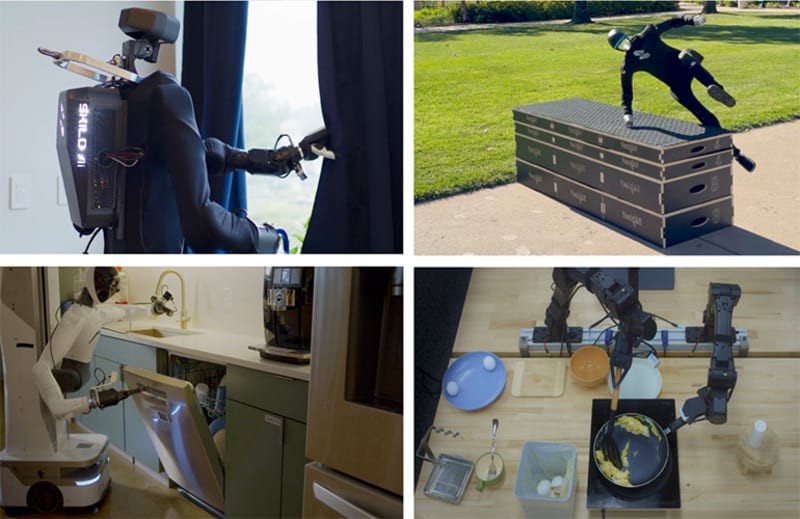
Skild AI Raises $1.4B for Robot Brain That Adapts to Any Body
A Pittsburgh startup just secured $1.4 billion to build a universal AI brain that can control any robot, from humanoids to delivery bots, without special training. The technology adapts in real time to broken parts, new environments, and even completely different robot bodies.
📺 Watch the full story above
Imagine a single brain that could control a four-legged dog robot, a humanoid, and a warehouse arm without needing special instructions for each one. That future just got $1.4 billion closer to reality.
Skild AI announced this week it has raised the massive funding round to develop what it calls the Skild Brain, the first unified foundation model for robotics. Founded just two years ago in Pittsburgh, the company has already reached a $14 billion valuation with a technology that solves one of robotics' biggest challenges.
Traditional robots are built for specific tasks with custom programming. If something breaks or the environment changes, they often fail. The Skild Brain works differently, adapting on the fly to whatever body it inhabits and whatever obstacles it encounters.
The technology has already demonstrated remarkable flexibility. When a robot loses a limb, gets a jammed wheel, or faces slippery terrain, the Skild Brain adjusts in real time without any reprogramming. It can even transfer to a completely new robot body it has never controlled before.
"The model is forced to adapt rather than memorize, much like intelligence in nature," explained Deepak Pathak, co-founder and CEO of Skild AI. The system learns by watching human videos on the internet and practicing in physics simulations, bypassing the traditional need for massive robotics datasets that don't exist yet.
The company is already putting the technology to work in security patrols, warehouse operations, manufacturing facilities, data centers, and construction sites. In just a few months of 2025, Skild AI has grown from zero to $30 million in revenue.
Major players are betting big on this vision. SoftBank Group led the funding round, with investments from NVIDIA, Jeff Bezos through Bezos Expeditions, and strategic partners including Samsung, LG, Schneider, and CommonSpirit Health.
The Ripple Effect: This breakthrough could transform entire industries struggling with labor shortages and dangerous working conditions. Robots that can truly adapt mean safer construction sites, more efficient warehouses, and eventually helpful assistants in our homes. Manufacturing jobs could return to America with automation that's flexible enough to build diverse products without expensive retooling.
The company plans to start with enterprise applications before bringing the technology into consumer homes, using the new capital to scale up training and deployment.
More Images


Based on reporting by The Robot Report
This story was written by BrightWire based on verified news reports.
Spread the positivity! 🌟
Share this good news with someone who needs it


