Three Robots Team Up to Map Moon's Lava Caves
A team of autonomous robots just proved they can explore dangerous underground lava tunnels that could shelter future astronauts on the Moon. The successful test in Spain's volcanic caves brings us one step closer to safe lunar bases.
Three smart robots working as a team have cracked a major challenge for future Moon explorers: how to safely investigate the underground lava tunnels that could become humanity's first extraterrestrial home.
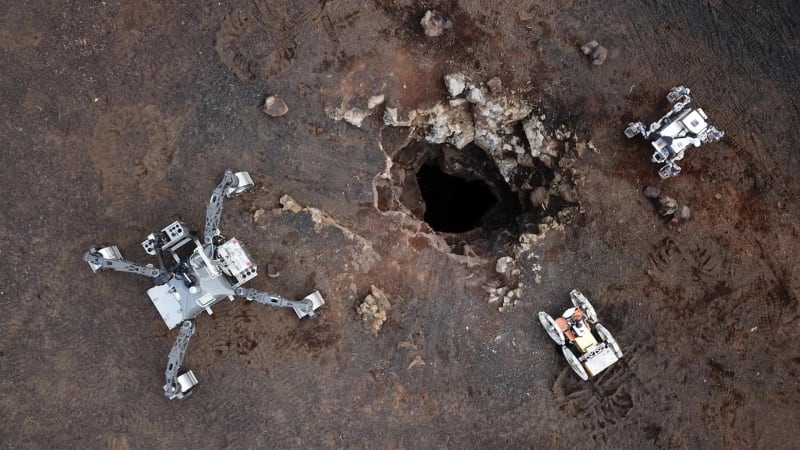
Scientists from the University of Malaga and partners across Europe tested their robotic trio in the volcanic caves of Lanzarote, Spain, in February 2023. The mission simulated what these robots would need to do on the Moon, where ancient lava tubes offer natural protection from deadly radiation and meteorite impacts.
The robots work together through four careful stages. First, they map the entrance of the lava tunnel as a team. Then they drop a sensor-packed cube into the darkness to gather initial readings. Next comes the most dramatic part: a scout rover rappels down into the cave like a mechanical mountaineer. Finally, the team creates detailed 3D maps of the entire underground space.
These lava tunnels exist because billions of years ago, flowing lava created hollow tubes beneath the surface of the Moon and Mars. Today, those same structures could save lives by shielding astronauts from the harsh space environment that bombards anyone on the surface.
The challenge has always been reaching these tunnels safely. Entry points are scarce and dangerous. The terrain is rough and unpredictable. Human exploration would be incredibly risky.
That's where autonomous robots change everything. The European team, led by the German Research Center for Artificial Intelligence, designed these three machines to handle the dangers without putting people at risk.
The Ripple Effect
This successful test does more than prove robots can explore caves. It demonstrates that teams of different robots can work together without human guidance, making split-second decisions in environments we've never seen before.
The Space Robotics Laboratory at the University of Malaga has been developing this technology through close partnership with the European Space Agency. Their work focuses on making planetary rovers smarter and more independent, capable of planning their own routes and solving unexpected problems.
Students at the University of Malaga's School of Industrial Engineering are already training on these systems through internships and thesis projects. They're learning skills that will directly support future Moon and Mars missions.
The research, published in Science Robotics, confirms the mission concept works in real conditions. The robots performed exactly as designed in Lanzarote's challenging volcanic environment, which closely mimics what they'll face on the Moon.
Future lunar explorers may owe their safety to these three robots and the teams that built them, turning science fiction dreams of underground Moon bases into engineering reality.
Based on reporting by Science Daily
This story was written by BrightWire based on verified news reports.
Spread the positivity!
Share this good news with someone who needs it