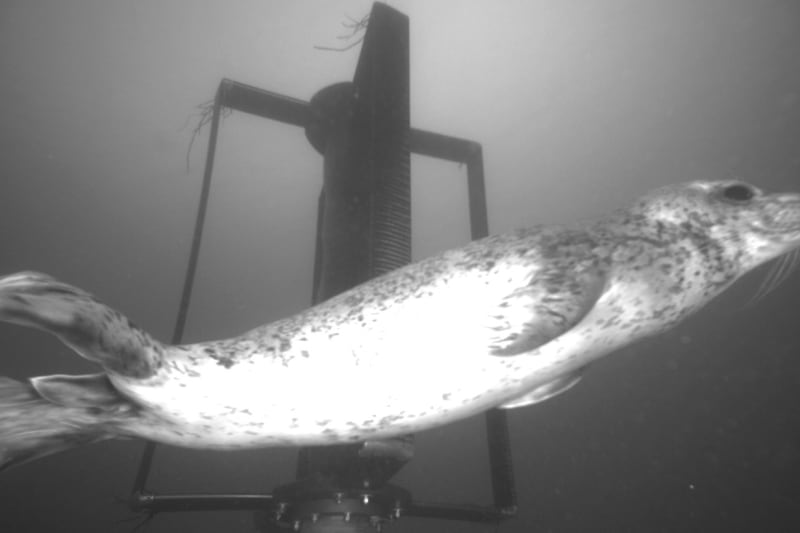
Underwater Cameras Show Tidal Turbines Are Safe for Seals
After watching 1,044 interactions between marine life and underwater turbines in Washington state, researchers found zero collisions with seals or seabirds. This breakthrough data could finally unlock America's stalled tidal energy industry, which has the potential to power 21 million homes with predictable, carbon-free electricity.
Seals approached with curiosity. Birds dove and naturally steered clear. Fish swam through spinning blades with a 98 percent safety rate, and not a single animal died.
For 109 days, underwater acoustic cameras captured something the tidal energy industry desperately needed: proof that marine life can safely coexist with underwater turbines. At Sequim Bay in Washington state, Pacific Northwest National Laboratory researchers documented over 1,000 interactions between animals and a small tidal turbine, finding zero collisions among seals and seabirds.
The study, released Wednesday, represents a turning point for an industry paralyzed by fear. Despite tidal energy's massive potential, U.S. projects rarely make it past permitting because regulators worried the turbines would act as underwater blenders for marine life.
Christopher Bassett, a University of Washington research scientist and study co-author, watched harbor seals display "strong swimming capabilities" as they expertly avoided the spinning rotors. The marine mammals were clearly in control, approaching the turbine with what appeared to be playful curiosity before swimming away unharmed.
The technology behind this discovery is as impressive as the findings. AI-driven software learned to ignore drifting debris while strobe lights captured photos only when animal silhouettes appeared, revealing behavior in total darkness that scientists had never observed before.
Out of 92 seal visits and 406 bird encounters, not one animal made contact with the turbine. Among 224 individual fish and five schools that passed through, only four fish were struck, and three of those kept swimming, suggesting even direct contact wasn't necessarily fatal.
The contrast with other countries is stark. South Korea's Sihwa Lake Tidal Power Station powers a city of 500,000 people. Meanwhile, American projects like the San Francisco Bay Tidal Energy Project stall in regulatory limbo, waiting for the kind of data this study finally provides.
Why This Inspires
This research proves that innovation doesn't have to come at nature's expense. The same underwater cameras that protect marine life could be scaled up to monitor larger turbines, creating a path forward that satisfies both environmental concerns and clean energy goals.
Elisa Obermann, executive director of Marine Renewables Canada, called the findings "a positive milestone for the industry and a significant step forward." After years of regulatory gridlock caused by legitimate environmental questions, scientists now have answers backed by thousands of hours of underwater observation.
The technology even captured kelp crabs, jellyfish, and krill drifting past, painting a complete picture of how ocean ecosystems adapt to these structures.
With the Department of Energy estimating tidal energy could power 21 million homes, this breakthrough couldn't come at a better time. The ocean's tides are completely predictable, making them more reliable than solar or wind, and now we know they can be harnessed safely.
America's clean energy future might just be waiting beneath the waves, and the seals have given their approval.
Based on reporting by Inside Climate News
This story was written by BrightWire based on verified news reports.
Spread the positivity! 🌟
Share this good news with someone who needs it