Webb Telescope Captures Sharpest Ever Black Hole Image
NASA's James Webb Space Telescope just delivered the clearest view ever of a supermassive black hole's neighborhood, solving a 30-year mystery about where mysterious infrared light comes from. The breakthrough could reshape how we understand black holes feeding at the hearts of galaxies.
📺 Watch the full story above
Scientists just got their closest look ever at a feeding black hole, and what they found surprised everyone.
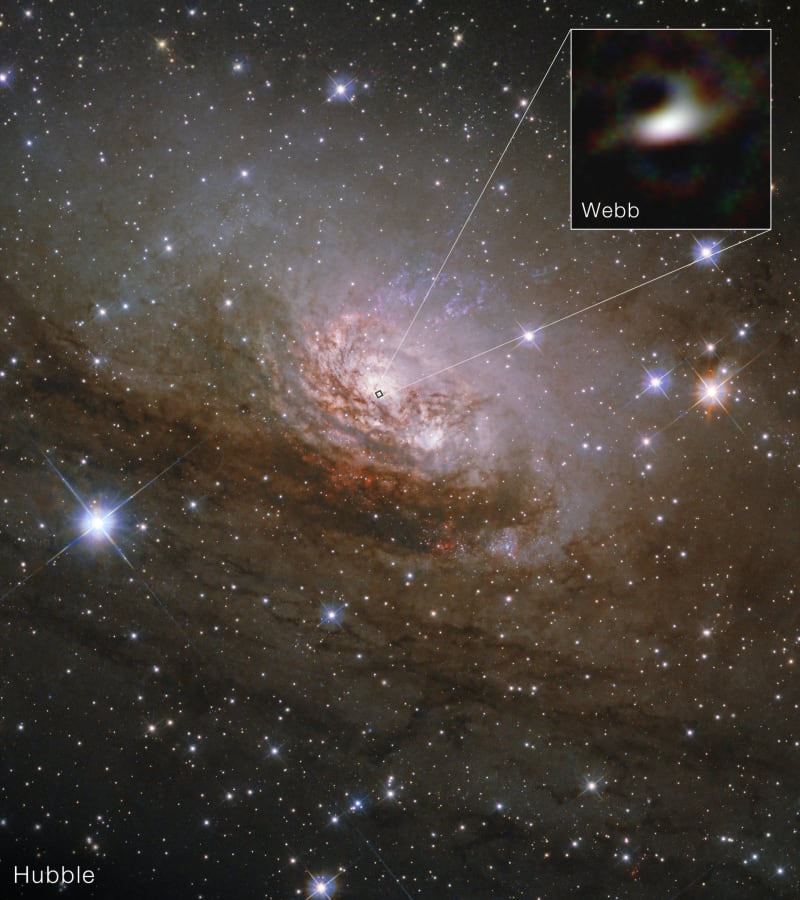
The James Webb Space Telescope peered into the Circinus Galaxy, located 13 million light-years away, and captured the sharpest image ever taken of the region surrounding a supermassive black hole. Using a special technique that essentially doubled the telescope's resolution, researchers achieved clarity equivalent to using a 13-meter space telescope instead of Webb's actual 6.5-meter mirror.
The breakthrough solved a puzzle that's stumped astronomers since the 1990s. Scientists had long detected excess infrared light coming from galaxy cores but couldn't pinpoint its source because the regions were too bright and dense to see clearly.
Previous models suggested most of this infrared glow came from powerful outflows of superheated material blasting away from black holes. But Webb's new observations revealed the opposite is true.
The telescope showed that 87% of the infrared emission actually comes from the dusty torus closest to the black hole itself, the region where material actively feeds into it. Less than 1% comes from outflows. The remaining 12% originates from hot dust located farther out that previous instruments couldn't distinguish.
Lead researcher Enrique Lopez-Rodriguez from the University of South Carolina explained that Webb's observations represent the first time a space-based infrared interferometer has studied an object beyond our galaxy. The team used a special mask with seven hexagonal holes that transforms light into interference patterns, allowing scientists to reconstruct images in exceptional detail.
The discovery was made possible by Webb's Aperture Masking Interferometer, which filtered out obscuring starlight and separated different sources of infrared emission. This advanced imaging mode lets astronomers see features twice as sharp as normal observations.
Why This Inspires
This isn't just about one black hole. The same technique can now be applied to study dozens of other black holes across the universe, helping scientists understand how these cosmic giants shape galaxy evolution.
Researcher Julien Girard from the Space Telescope Science Institute hopes the work will inspire other astronomers to use this powerful tool for studying faint structures near bright objects throughout space. Building a catalog of black hole emission data will reveal whether Circinus represents a common pattern or a unique case.
The findings prove that even 30 years into a scientific puzzle, new tools can deliver answers that completely flip our understanding. Webb continues opening windows into cosmic mysteries we've never been able to solve before, bringing the universe's most extreme environments into focus for the first time.
Based on reporting by Google: James Webb telescope
This story was written by BrightWire based on verified news reports.
Spread the positivity! 🌟
Share this good news with someone who needs it