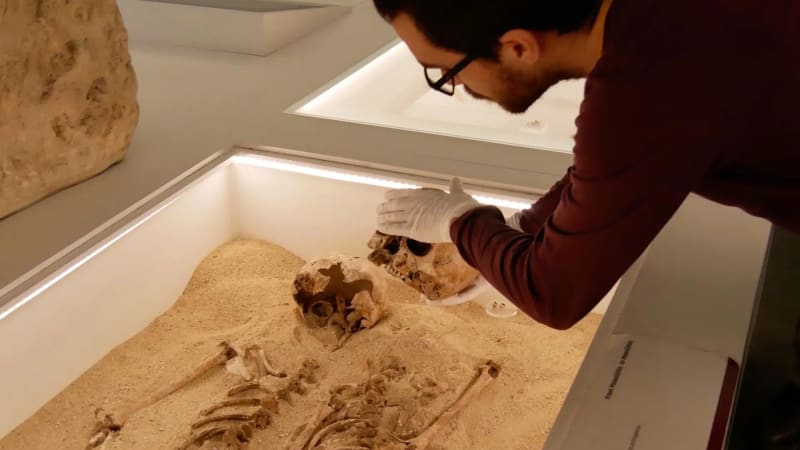
12,000-Year-Old Burial Solves Ancient Medical Mystery
Scientists just diagnosed a rare genetic condition in a mother and daughter who lived over 12,000 years ago, proving that communities cared for vulnerable members even during the Ice Age. The discovery marks the earliest genetic diagnosis ever made in human history.
A mother cradling her daughter for over 12,000 years has just revealed a secret written in their bones and DNA.
Researchers from the University of Vienna discovered that two Ice Age women buried together in southern Italy shared a rare genetic condition affecting bone growth. The younger woman, who lived as a teenager or young adult, had severe short stature at just 3 feet 7 inches tall. Her mother, at 4 feet 9 inches, was also shorter than average for the time.
For decades since the burial's discovery in 1963, scientists debated who these people were and why they looked different. The answers lay hidden in their DNA.
By extracting genetic material from the skeletons, researchers identified mutations in the NPR2 gene, which controls bone development. The daughter had two altered copies of the gene, causing acromesomelic dysplasia, a very rare disorder that severely shortens limbs. Her mother carried just one altered copy, explaining her milder short stature.
This marks the earliest genetic diagnosis ever made in humans. Ron Pinhasi, who co-led the study, says the work shows how ancient DNA analysis can identify specific mutations in prehistoric individuals and reveal how far back rare diseases existed.
Daniel Fernandes, the study's first author, notes that identifying both as closely related females turns this into a familial genetic case. The same gene affected both women differently depending on whether they inherited one or two altered copies.
Why This Inspires
The most remarkable part isn't just the scientific breakthrough. It's what the younger woman's survival tells us about Ice Age communities.
Despite severe physical challenges in a harsh environment, she lived well into adolescence or adulthood. That wouldn't have been possible without consistent support from her group.
Alfredo Coppa from Sapienza University explains that her survival would have required sustained help with food and mobility in a challenging Ice Age landscape. Someone had to care for her, day after day, year after year.
The tender burial itself, with the older woman's arms around the younger, speaks to a bond that transcends time. These weren't just specimens for study. They were people who loved each other.
Adrian Daly of Liège University Hospital Centre points out that rare genetic diseases aren't a modern phenomenon but have existed throughout human history. Understanding their deep roots may even help doctors recognize such conditions today.
This Ice Age embrace reminds us that compassion and community care aren't modern inventions but fundamental parts of being human.
Based on reporting by Science Daily
This story was written by BrightWire based on verified news reports.
Spread the positivity!
Share this good news with someone who needs it