125-Million-Year-Old Fossil Mussels Found Nursing Their Babies
Scientists discovered ancient freshwater mussels perfectly preserved with their developing young still tucked inside their gills, captured in stone for 125 million years. The find rewrites what we know about how these animals survived in an age of dinosaurs.
Freshwater mussels don't look like devoted parents, but females shelter their babies inside their own gills before releasing them into the world. Scientists just found that same tender care frozen in stone from the age of dinosaurs.
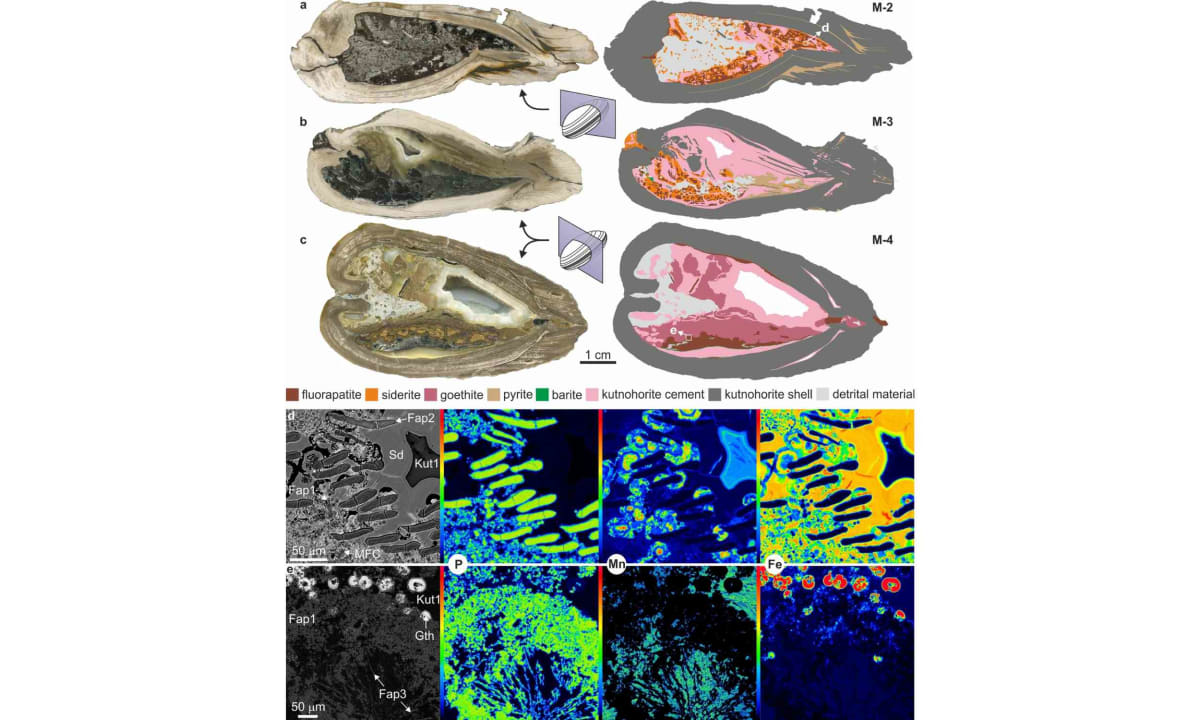
The discovery happened on the Isle of Wight, that famous stretch of English coast known for Iguanodon bones and other dinosaur treasures. Three fossils from 125 million years ago held something no one expected to see: baby mussels at different stages of growth, still nestled in their mother's gills exactly where she placed them.
Dr. Graciela Delvene at the Geological and Mining Institute of Spain led the team that sliced the fossils open and studied them under powerful microscopes. What they found was extraordinary. The soft tissue that usually rots away had turned to minerals, preserving every detail of the brooding chambers where embryos grew.
Victorian naturalists spotted dark material inside these shells almost 200 years ago and called it "Molluskite" without understanding what they were seeing. Now we know they were looking at the oldest mother and babies ever found together in the fossil record.
The most developed larvae lay with their tiny shells open in what researchers call a butterfly position. They were days or weeks away from being released into the river when something buried them in sediment that would become stone.
Why This Inspires
Freshwater is tough on shell builders because it holds far less calcium than the ocean. These ancient mothers solved that problem the same way modern mussels do, by storing calcium as tiny grains throughout their bodies and feeding it to their developing young.
The fossils captured the actual transfer happening. Calcium grains appeared both outside the embryos and inside them, showing babies pulling in the stored mineral to build their first shells while still protected in their mother's gills. No one had ever seen that process preserved in stone before.
One of the three mussels held no babies at all, and that empty shell told its own story. It still contained unused calcium stores and had thinner gill tissue, marking an animal that never bred. Together, the three fossils showed different moments in one reproductive cycle, allowing scientists to reconstruct the entire sequence.
This care strategy helped freshwater mussels spread across rivers and lakes through the dinosaur era and beyond. They've been doing it the same way for 125 million years, an unbroken chain of mothers sheltering their young that survives today.
The discovery matters now because freshwater mussels are among the most threatened animals alive. Knowing how long this reproductive strategy has worked gives conservation scientists a deeper evolutionary record as they fight to protect modern species facing extinction.
Stone preserved what usually disappears, and inside those ancient shells, devotion endured.
Based on reporting by Google: fossil discovery
This story was written by BrightWire based on verified news reports.
Spread the positivity!
Share this good news with someone who needs it