160,000-Year-Old Tools Rewrite East Asian Human History
Archaeologists in central China discovered sophisticated stone tools with handles dating back 160,000 years, proving ancient humans in East Asia were just as inventive as their African and European counterparts. The find shatters decades of assumptions about early human innovation.
Scientists just discovered that ancient humans in China were master craftspeople 160,000 years ago, completely overturning what we thought we knew about early human ingenuity.
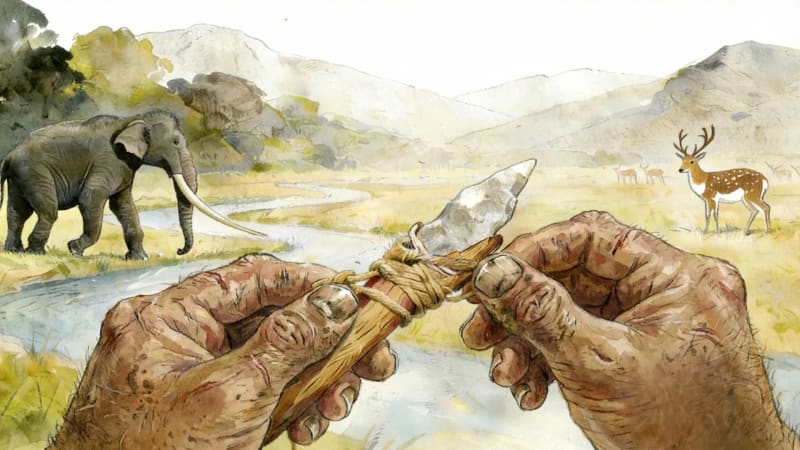
An international team led by the Chinese Academy of Sciences uncovered remarkable stone tools at the Xigou site in central China's Danjiangkou Reservoir Region. These weren't simple rocks chipped into rough edges. They were carefully designed tools with handles attached, representing the earliest known composite tools ever found in East Asia.
"Researchers have argued for decades that while hominins in Africa and western Europe demonstrated significant technological advances, those in East Asia relied on simpler and more conservative stone-tool traditions," said expedition leader Dr. Shixia Yang. The Xigou discovery proves that assumption completely wrong.
The tools date from 160,000 to 72,000 years ago, spanning an impressive 90,000-year archaeological record. The site's inhabitants used advanced techniques to create small, versatile tools for different tasks. They planned ahead, combined materials thoughtfully, and adapted their technology as environments changed around them.
What makes hafted tools special is their complexity. Creating a tool with a handle requires understanding how different materials work together, planning multiple steps ahead, and possessing fine motor skills. It's evidence of sophisticated thinking, not primitive survival instincts.
The timing matters too. During this period, several large-brained human species lived in China, including Homo longi and Homo juluensis, possibly alongside Homo sapiens. The diverse population may explain the behavioral complexity shown in the stone tool collections.
Professor Michael Petraglia of Griffith University's Australian Research Centre for Human Evolution emphasized how significant this is. "The Xigou findings challenge the narrative that early humans in China were conservative over time," he said.
Why This Inspires
For too long, scientists assumed innovation happened primarily in Africa and Europe while humans elsewhere stayed stuck in their ways. The Xigou discovery reminds us that human creativity and adaptability have always been universal traits, regardless of geography.
These ancient toolmakers faced dramatic environmental changes over 90,000 years. They didn't just survive. They innovated, improved their designs, and passed knowledge down through countless generations. Their technological strategies helped them thrive through climate shifts and changing landscapes.
Dr. Jian-Ping Yue, the study's lead author, summed it up perfectly: "Their presence indicates the Xigou hominins possessed a high degree of behavioural flexibility and ingenuity." These weren't simple creatures reacting to their world. They were problem-solvers shaping it.
The research confirms that early populations across China had cognitive and technical abilities matching those anywhere else on Earth, contributing equally to humanity's remarkable journey of innovation that continues today.
Based on reporting by Science Daily
This story was written by BrightWire based on verified news reports.
Spread the positivity!
Share this good news with someone who needs it
%2Fhttps%3A%2F%2Ftf-cmsv2-smithsonianmag-media.s3.amazonaws.com%2Ffiler_public%2F4e%2F9f%2F4e9f0fe8-aa48-438a-b88f-3a29cd71107e%2Fhttps___wwwfrontiersinorg_files_articles_1758862_xml-images_fmats-13-1758862-g001.jpeg)
%2Fhttps%3A%2F%2Ftf-cmsv2-smithsonianmag-media.s3.amazonaws.com%2Ffiler_public%2F8e%2F83%2F8e837bc6-e2b3-4bb6-bb1c-4f1287b45a6f%2Fcastillo-39-rincon_de_los_signos.jpg)