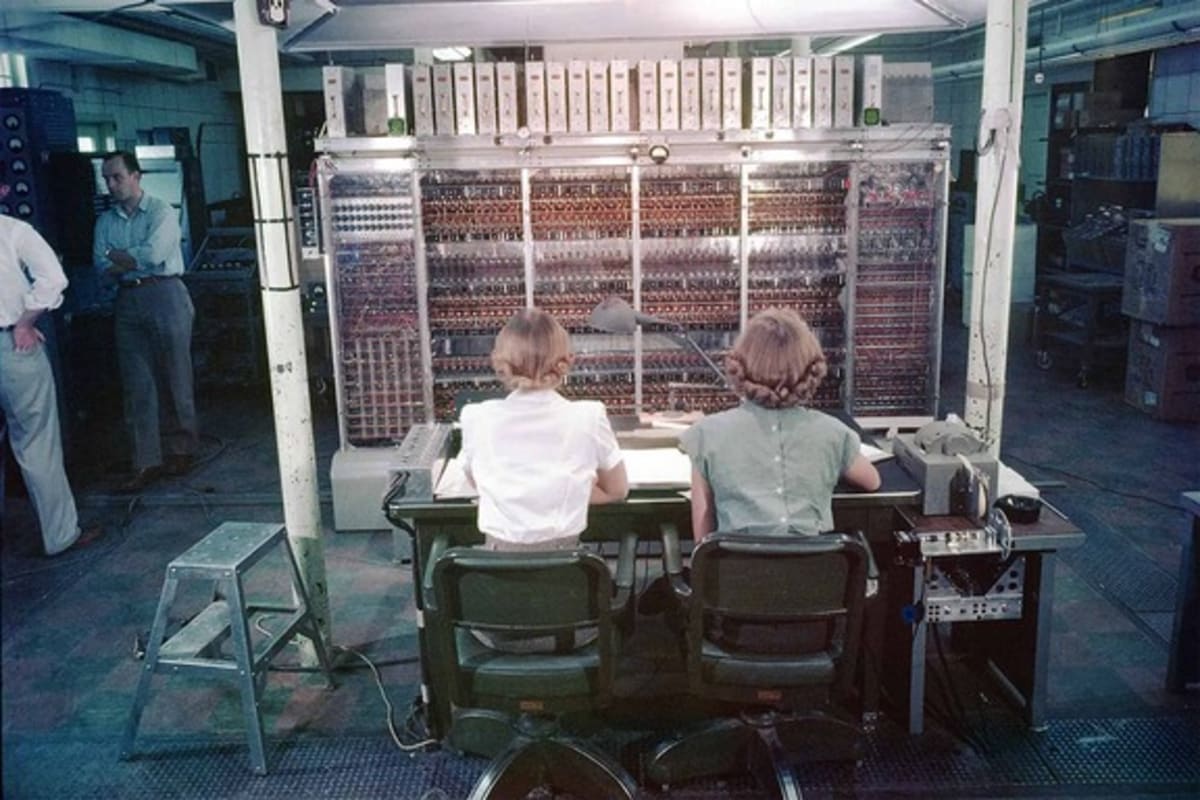
1955 Computer Experiment Unlocked Science of Chaos
A young programmer at Los Alamos helped discover why some complex systems can't be predicted the way scientists once thought. That 1955 breakthrough created an entirely new field that helps us understand everything from weather to fusion energy today.
In 1955, Mary Tsingou sat in front of one of the world's first computers and watched it print results that would change science forever. The young programmer at Los Alamos National Laboratory, working alongside physicist Enrico Fermi, had just helped prove something shocking: some of nature's most important systems simply can't be predicted the way scientists believed.
Their numerical experiment revealed that complex systems like weather patterns, ocean currents, and fusion plasmas behave in ways that make long-term prediction impossible. It wasn't a failure of math or computing power. It was a fundamental truth about how nature works.
The discovery launched an entirely new field called nonlinear dynamics. Scientists finally had tools to understand why forecasting weather beyond a week remains so difficult, or why certain physical systems behave unpredictably even when following strict mathematical rules.
For decades, this breakthrough remained somewhat theoretical. But Los Alamos researchers have since transformed that insight into practical capabilities that protect national security and advance scientific discovery.
The Ripple Effect
Today's scientists at Los Alamos are building on Tsingou's legacy with cutting-edge AI systems designed specifically for unpredictable problems. Their new framework, called URSA, helps researchers navigate the uncertainty that comes with modern scientific challenges.
The lab now uses machine learning to connect extreme astrophysical observations to the physics governing matter and energy. They're exploring which complex systems quantum computers might actually help us understand, and which ones classical computers can handle just fine.
From early supercomputing efforts to today's exascale machines, Los Alamos has spent nearly 70 years expanding our ability to model increasingly complex systems. Each advance traces back to that moment when Tsingou and her colleagues proved that chaos isn't randomness or disorder, but a structured feature of how nature works.
Understanding unpredictability has become one of the lab's core strengths. Scientists there now routinely tackle problems that would have seemed impossible before 1955, when a young programmer helped reveal one of the universe's most important secrets.
Based on reporting by Google: scientific discovery
This story was written by BrightWire based on verified news reports.
Spread the positivity!
Share this good news with someone who needs it