3 Brothers Left Corporate Jobs, Trained 2,000 Farmers
Three brothers in rural India walked away from stable corporate careers to start a pearl farm with 2,000 oysters. Now they've trained 2,000 families in sustainable farming, keeping entire communities from migrating to cities for work.
When Shwetank Pathak turned down a teaching career to farm oysters in his backyard in 2018, his family thought he was taking a risk. Eight years later, his pearl farming operation supports 2,000 rural families across India.
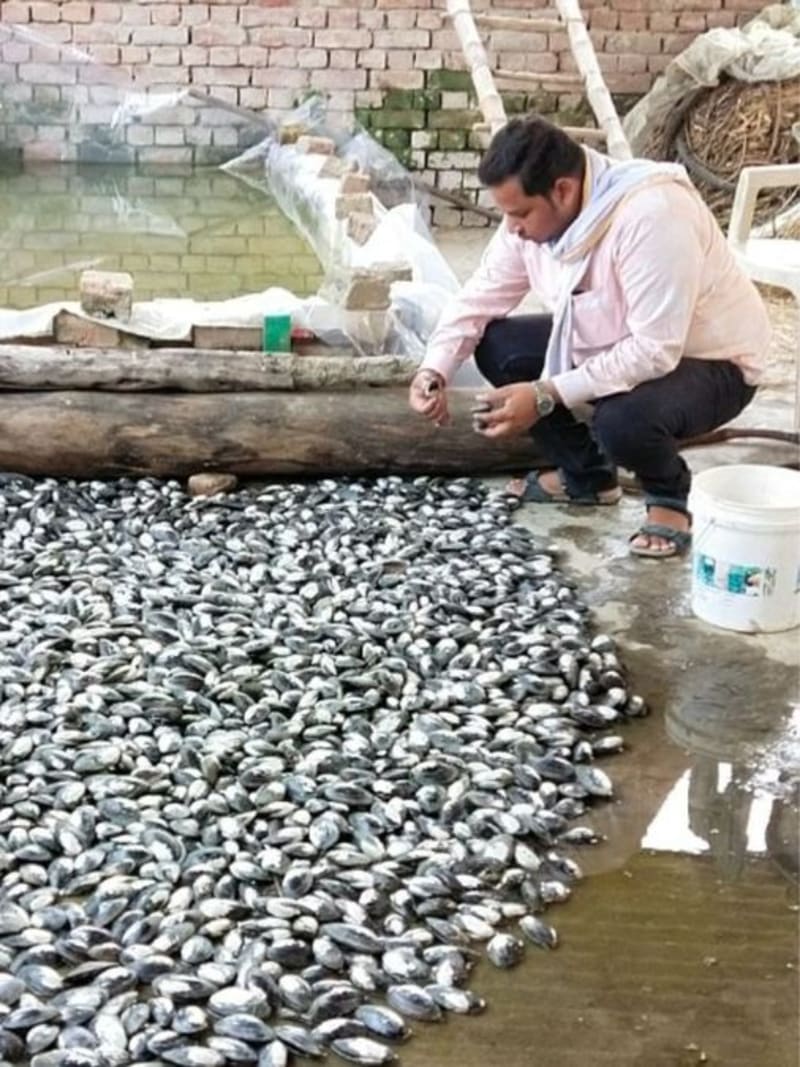
Shwetank started with a simple idea in Narayanpur village, Uttar Pradesh. After training at the Central Institute of Freshwater Aquaculture in Orissa, he transformed a small pond behind his house into the village's first pearl farm with just 2,000 oysters.
The venture proved so promising that his brothers Rohit and Mohit, plus their uncle Jalaj Jeevan Pathak, all quit their corporate jobs to join him. They saw pearl farming as more than a business opportunity; it was a chance to reverse rural migration.
Pearl farming requires patience and precision. The brothers implant small nuclei into oysters, then wait anywhere from three months to three years for pearls to form. Each pearl sells for 90 to 200 rupees (about $1 to $2.50).
Within a few years, the family scaled from 2,000 to over 50,000 oysters across multiple districts. They also diversified into goat rearing and exotic vegetables like mushrooms, creating multiple income streams for their community.
But the real transformation came in 2020 when they launched Agrikaash. This training initiative teaches local farmers pearl farming, beekeeping, and sustainable livestock practices. The goal: help people earn decent livings without leaving their hometowns.
"We're helping farmers stay in their hometowns rather than migrate in search of jobs," Rohit explains. Their uncle Jalaj adds, "We spent many years working in big corporations, but always felt the need to return to our roots and help the local people."
The Ripple Effect
The impact reaches far beyond pearl harvests. By keeping 2,000 families rooted in rural areas, the Pathaks are preserving entire communities. Children stay in local schools, elderly parents keep their support systems, and villages maintain their populations instead of hollowing out.
The family has received recognition from various organizations for promoting self-reliance and creating sustainable employment. Now they're expanding into Madhya Pradesh, Bihar, and West Bengal, ready to bring their knowledge to even more farming communities.
What started as one man's backyard experiment has become a blueprint for rural economic development. The Pathak brothers prove that sometimes the biggest corporate success means leaving the corporate world behind.
Based on reporting by The Better India
This story was written by BrightWire based on verified news reports.
Spread the positivity!
Share this good news with someone who needs it