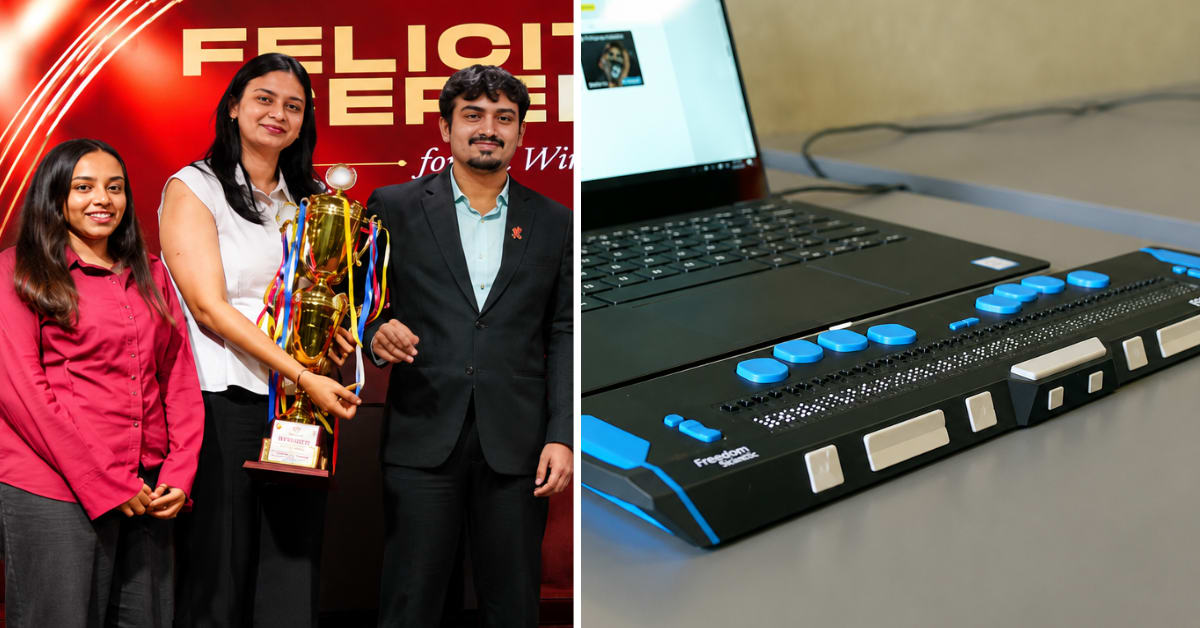
3 Students Built Touch-Based Coding Tool for Blind Kids
Three university students from India created TACTO, a device that teaches coding through buttons, sensors, and sound instead of screens. It just won first place at a global innovation competition in Hong Kong.
For millions of visually impaired children, learning to code has always meant being locked out before they even begin.
Three students from Galgotias University in Greater Noida, India decided that wasn't good enough. They built TACTO, a hands-on device that teaches coding concepts through touch, sensors, and audio feedback with no screen required at any step.
The innovation works by making programming physical. Instead of reading lines of code on a monitor, students press buttons and interact with sensors to learn sequencing, loops, and conditionals. Audio feedback guides them through each lesson, turning abstract concepts into something they can feel and hear.
India is home to nearly 5 million blind people and 35 million visually impaired people, making up about one-fourth of the world's visually impaired population. For most of them, traditional coding tools built around screens and visual feedback have been impossible to use from day one.
The problem often starts even earlier than coding class. Many visually impaired students are steered away from science and technology subjects in elementary school through subtle discouragement or institutional barriers. By the time they're old enough to learn programming, years of being told STEM isn't for them have already taken their toll.
TACTO challenges that entire system. The device proves that coding education doesn't have to rely on sight when it's designed thoughtfully from the start.
The team behind it includes Gaurang Pant, a third-year computer science student, Shristi Mandoliya, a second-year data science student, and Kavya Singh, a third-year finance student. They were mentored by entrepreneur Rachit Mathur, who said working with them felt less like mentorship and more like collaborating with co-founders.
The Ripple Effect
TACTO recently took top honors at EDVentures 2026, an international student innovation competition held at The Education University of Hong Kong. The team competed against 19 teams from 10 countries, including entries from Nanyang Technological University in Singapore, King Saud University in Saudi Arabia, and Mahidol University in Thailand.
The win puts a spotlight on an accessibility gap that affects millions but gets little attention in mainstream tech education. When coding tools assume everyone can see, they quietly exclude a massive population from one of the most valuable skills of the century.
TACTO shows what becomes possible when designers start from a different question: not how to adapt existing tools for blind users, but how to build something that works for them from the ground up. That shift in thinking could open doors that have been closed for far too long.
The device is still in development, but the student team is already thinking about scale and reach. For visually impaired children across India and beyond, TACTO could be the first time someone told them technology is absolutely meant for them too.
More Images
%2Fenglish-betterindia%2Fmedia%2Fmedia_files%2F2026%2F06%2F18%2Favantika-featured-image-template-11-2026-06-18-14-30-09.png)

%2Ffilters%3Aformat(webp)%2Fenglish-betterindia%2Fmedia%2Fmedia_files%2F2026%2F06%2F18%2Favantika-featured-image-template-12-2026-06-18-14-45-34.png)
%2Fenglish-betterindia%2Fmedia%2Fmedia_files%2F2026%2F06%2F18%2Ffeatured-img-2026-06-18-19-46-34.png)
Based on reporting by The Better India
This story was written by BrightWire based on verified news reports.
Spread the positivity!
Share this good news with someone who needs it