307-Million-Year-Old Fossil Ate Plants Before It Was Cool
Scientists discovered one of Earth's earliest vegetarian land animals, a 10-inch creature that munched on ferns 307 million years ago. The find rewrites the timeline of when animals first started eating plants.
For millions of years after animals crawled onto land, they stuck to eating each other while ignoring the salad bar all around them. Now scientists have found one of the first creatures brave enough to try something different.
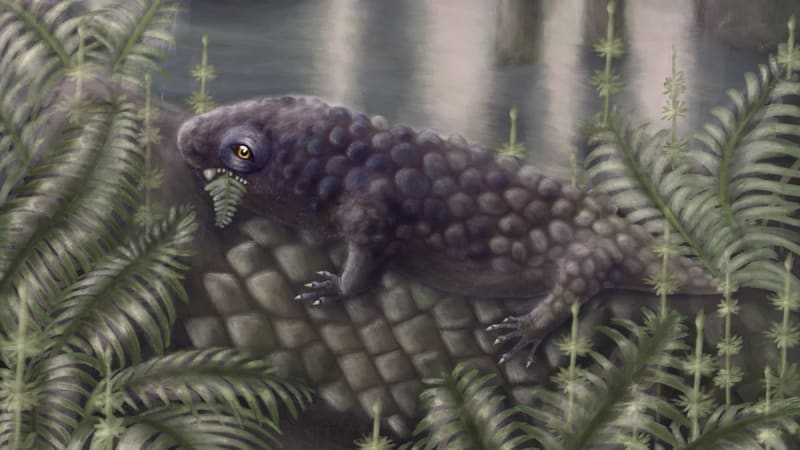
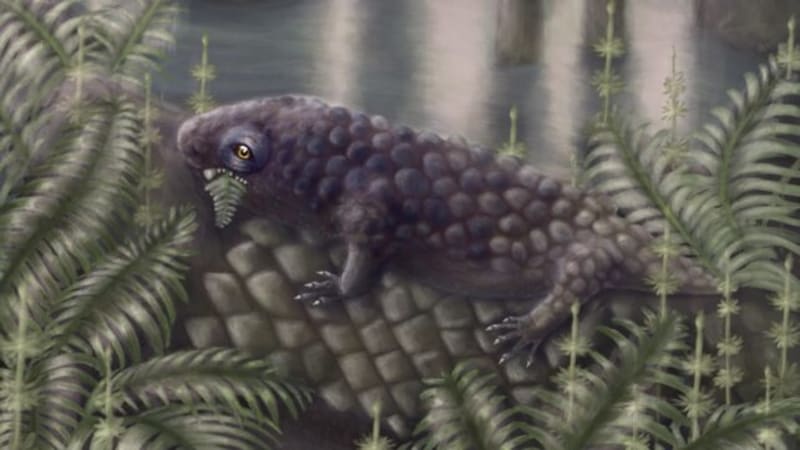
Meet Tyrannoroter heberti, a 10-inch long animal that lived 307 million years ago in what's now Nova Scotia, Canada. Despite having a name that sounds like a fearsome predator, this little guy was actually munching on ferns and breaking new ground as one of Earth's earliest herbivores.
Researchers discovered the fossil skull inside an ancient tree stump and used high-tech CT scanning to peek inside its mouth. What they found was remarkable: special bony plates called dental batteries that worked like built-in food processors, grinding tough plant material between the roof of its mouth and lower jaw.
"This is one of the oldest known four-legged animals to eat its veggies," says Arjan Mann, an evolutionary biologist at the Field Museum in Chicago who co-led the study. The discovery shows that plant-eating experiments started way earlier than scientists previously thought.
Tyrannoroter wasn't a strict vegetarian, though. The researchers believe it probably snacked on insects and arthropods when the opportunity arose, making it more of an opportunistic omnivore than a committed herbivore.
Here's where the story gets even more interesting. Those dental batteries might have originally evolved to crunch through tough insect exoskeletons, and some clever ancestor figured out they worked just as well on plants. Plus, eating plant-munching insects could have given these early tetrapods the right gut bacteria to digest plants themselves.
The Ripple Effect
After identifying these telltale plant-eating structures in Tyrannoroter, the research team went back and re-examined other similar fossils. They found the same features in specimens as old as 318 million years, pushing back the timeline of herbivory even further.
This discovery matters because it shows how quickly life adapts and experiments with new strategies. Within just a few tens of millions of years after animals permanently moved onto land, some were already figuring out how to tap into the abundant plant food source that had been waiting there for over 100 million years.
The findings connect directly to us, too. Tyrannoroter belonged to a group of animals related to the last common ancestor of all reptiles and mammals, meaning this little fern-eater is part of our own family tree.
Every major shift in how life works on Earth started with pioneers like Tyrannoroter, proving that sometimes the biggest breakthroughs come in small packages.
More Images

Based on reporting by Google News - Science
This story was written by BrightWire based on verified news reports.
Spread the positivity!
Share this good news with someone who needs it