307-Million-Year-Old Fossil Ate Plants, Rewriting History
Scientists discovered a football-sized creature from 307 million years ago that was one of the first land animals to munch on plants instead of meat. The finding rewrites what we thought we knew about how early animals adapted to life on land.
For millions of years after animals crawled onto land, they ignored the plants all around them and stuck to eating meat. A newly discovered fossil is changing that story in the most exciting way.
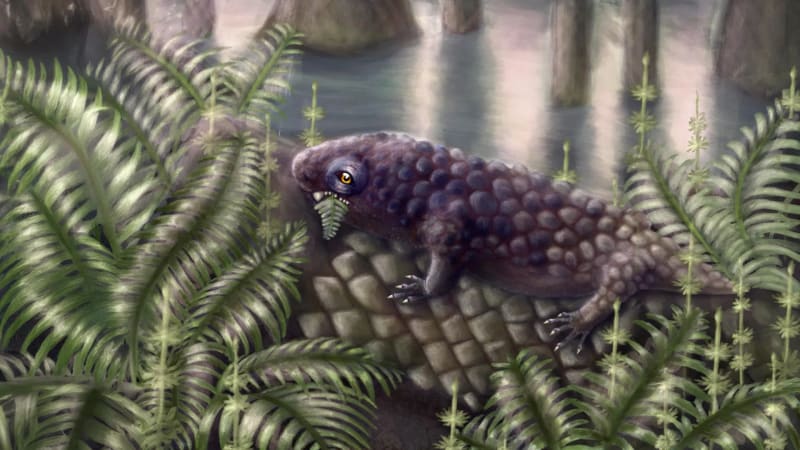
Meet Tyrannoroter heberti, a stocky creature about the size of an American football that lived 307 million years ago. Scientists just revealed that this ancient animal was one of the first land vertebrates to experiment with eating plants, pushing back the timeline of herbivory by millions of years.
The fossil was found on Cape Breton Island in Nova Scotia by Brian Hebert, an amateur paleontologist working in some seriously challenging conditions. The team had to race against the world's highest tides while excavating fossils from crumbling coastal cliffs.
When researchers at the Field Museum in Chicago first saw the heart-shaped skull, they knew they had something special. But the real surprises came when they used CT scanning to peek inside the closed mouth.
Hidden inside were rows of specialized teeth on the roof of the mouth, perfectly designed for crushing and grinding vegetation. This dental setup is a clear sign that Tyrannoroter was munching on ferns and other plants, not just hunting other animals.
The discovery matters because scientists previously thought herbivory developed much later in evolution. Tyrannoroter lived during a transition period when animals were becoming permanently adapted to life on dry land, before reptiles and mammals split into separate groups.
The animal probably wasn't a strict vegetarian, though. Like most herbivores today, it likely snacked on insects and small prey alongside its plant-based meals, making it more of an opportunistic omnivore.
The Ripple Effect
This finding opens new doors for understanding how life adapted to land. By showing that plant eating evolved earlier than we thought, it reveals that ancient animals were more flexible and experimental than previously believed. The discovery also highlights how much we still have to learn from fossils, and how amateur paleontologists like Brian Hebert can make contributions that reshape scientific understanding.
The research team continues studying related fossils from Nova Scotia's fossil-rich coastline. Each new discovery helps fill in the picture of how life transitioned from water to land, and how early vertebrates learned to thrive in their new environment.
Tyrannoroter heberti proves that even 307 million years ago, animals were already finding creative ways to survive and adapt.
Based on reporting by Google: fossil discovery
This story was written by BrightWire based on verified news reports.
Spread the positivity!
Share this good news with someone who needs it