4 Astronauts Return From Deepest Moon Mission in 50 Years
After a historic nine-day journey around the moon, four astronauts safely splashed down in the Pacific Ocean, completing humanity's deepest space voyage in over half a century. NASA is already preparing the next mission to eventually land humans on the lunar surface again.
Four astronauts just made history by traveling farther from Earth than any human in more than 50 years, and they're home safe with stories that will shape our future among the stars.
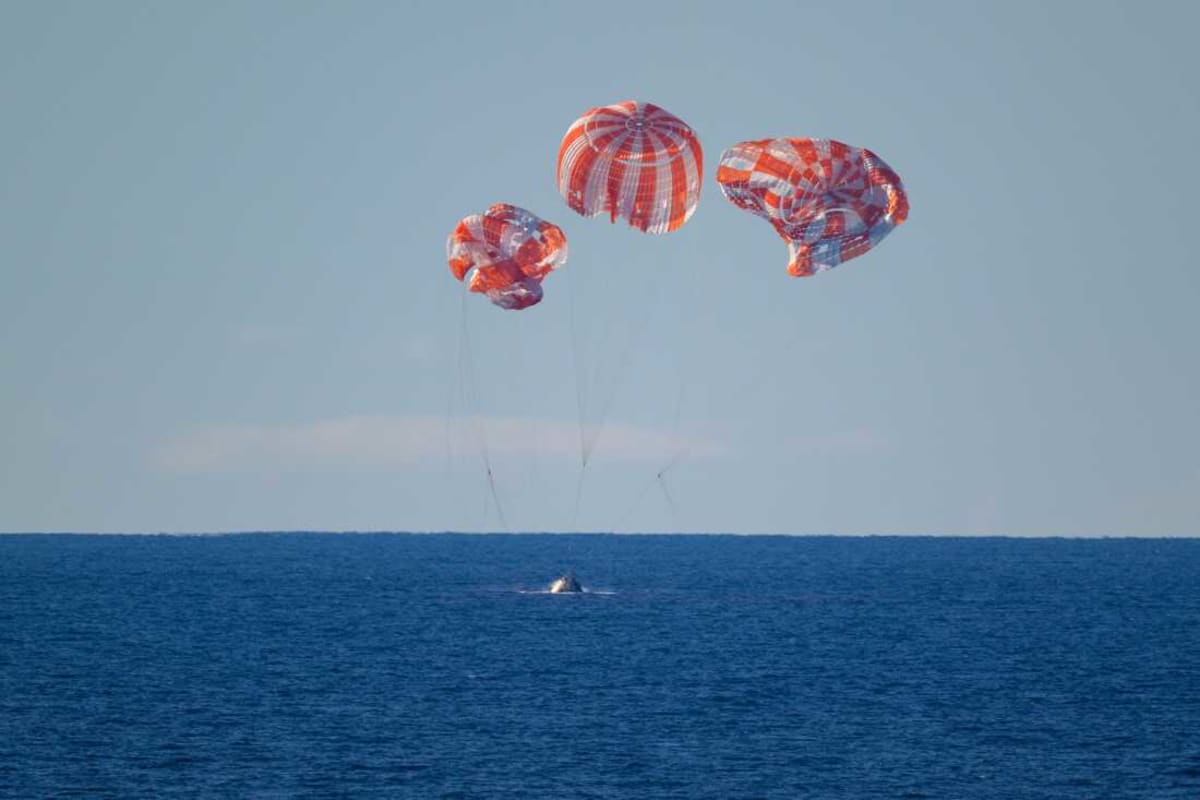
NASA astronauts Reid Wiseman, Victor Glover, Christina Koch, and Canadian Space Agency astronaut Jeremy Hansen splashed down in the Pacific Ocean off San Diego on Friday. Their Orion capsule had just survived a fiery return through Earth's atmosphere, enduring temperatures up to 5,000 degrees Fahrenheit and speeds 30 times faster than sound.
The nine-day Artemis II mission took the crew 4,000 miles above the moon's far side, covering more than 700,000 miles total. They tested critical spacecraft systems, captured thousands of photographs, and made geological observations to help scientists understand the moon's composition and origins.
But the most moving moment came when the astronauts looked back at our planet. "Trust me, you are special, in all of this emptiness," Glover radioed back. "This is a whole bunch of nothing, this thing we call The Universe. You have this oasis, this beautiful place that we get to exist together."
Within 24 hours of landing, all four crew members will arrive at Johnson Space Center in Houston. Navy dive teams pulled them from the capsule onto a raft, and helicopters whisked them to safety.
The Ripple Effect
This wasn't just a victory lap around the moon. Every system the crew tested brings NASA closer to landing humans on the lunar surface for the first time since 1972.
The crew even tested the spacecraft's toilet, a detail that matters when you're planning longer missions. Koch emphasized that her team views their role as part of a relay race, literally buying batons to hand to the next crew.
That next crew won't wait long. NASA is now launching an Artemis mission every year, and preparations for Artemis III have already begun at Kennedy Space Center in Florida.
The massive rocket core stage is arriving later this month. Engineers are moving the mobile launch pad back into the Vehicle Assembly Building next week to start stacking the next rocket.
Artemis III will launch next year to test landing spacecraft in Earth orbit. The mission after that, Artemis IV, could put human boots on the moon again.
"We did it. We sent four amazing people to the moon and safely returned them to Earth for the first time in more than 50 years," said NASA's Lori Glaze. "To the generation that now knows what we're capable of: Welcome to our moonshot."
The relay race to the moon is officially underway, and the finish line is closer than it's been in half a century.
More Images


Based on reporting by NPR Science
This story was written by BrightWire based on verified news reports.
Spread the positivity!
Share this good news with someone who needs it