
4-Minute Daily Routine Cuts Fall Risk for Seniors
Older adults who spent just four minutes a day on simple strength exercises saw dramatic improvements in balance and mobility after 12 weeks. The Penn State study offers hope for the 80% of seniors who struggle to meet standard exercise guidelines.
Getting older doesn't have to mean losing your independence, and now researchers have proof that staying strong takes far less time than you might think.
Scientists at Penn State College of Medicine discovered that seniors who performed a simple four-minute daily routine dramatically improved their balance, mobility, and leg strength in just three months. The best part? Every exercise can be done at home without expensive equipment or a gym membership.
The study followed 97 sedentary adults over 65, with an average age of 74. Before the program started, these participants were only getting about 18 minutes of total physical activity each week. Half the group began doing four basic movements: push-ups, chair stands, resistance-band rows, and stair stepping. Each exercise lasted 30 seconds, followed by a 30-second rest.
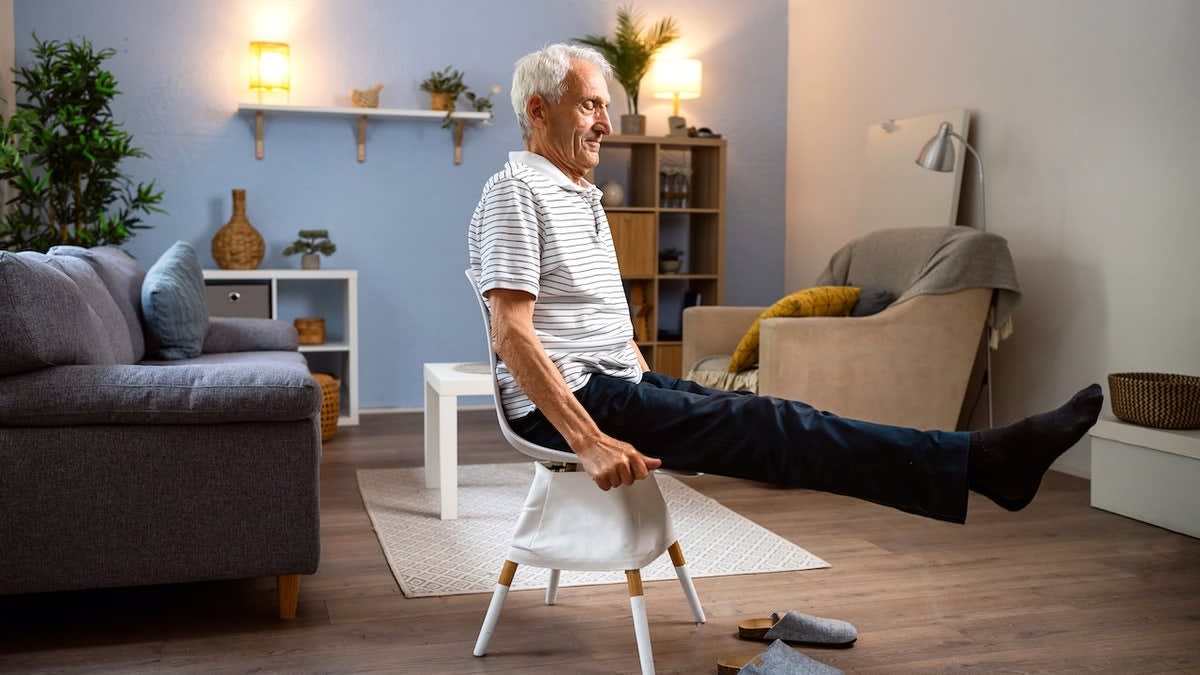
The routine was designed to be ultra-accessible. Participants could do push-ups against a kitchen counter or wall if floor push-ups felt too challenging. Those struggling with chair stands could use their hands on their knees for support.
After 12 weeks, the results told a powerful story. The exercise group performed an average of four more chair-stand repetitions than those who didn't exercise. They also shaved 2.3 seconds off their time standing up and sitting down five times consecutively. Their one-legged balance time improved by 3.6 seconds.
These numbers matter more than they might seem. "These indicators predict your future ability to go into a nursing home, your future likelihood of falling and of developing difficulty walking," explained lead author Christopher Sciamanna, a professor of medicine and public health at Penn State. "They give you a sense of whether or not you're going to be able to be active in the future."
Standard health guidelines recommend at least 150 minutes of moderate exercise weekly. But fewer than one in five older adults meet the muscle-strengthening recommendations. The research team wanted to find out if less could still mean more.
The Bright Side
By keeping the routine short, researchers eliminated the biggest barriers older adults face: time constraints and exhaustion. The result? Participants completed their workouts on 81% of tracked days, a remarkably high rate compared to traditional home exercise programs.
"Exercise is actually really complicated, because you have to decide how many repetitions, how far, how many sets, how much rest and how many times per week," noted co-author Smita Dandekar, an associate professor of pediatrics at Penn State. "It's hard work, so if we can make it short, we're part of the way there."
As participants grew stronger over the 12 weeks, they could increase difficulty by trying exercises without modifications or raising the height of their stepper. The program gave them written instructions and provided four elastic resistance bands plus an adjustable step platform.
The study, published in PLOS One, tracked a relatively small group over a short timeframe, so researchers acknowledge they don't yet know if these gains last long-term or how the routine might help seniors already using walkers or canes.
Four minutes a day might just be the key to keeping older adults active, independent, and living in their own homes longer.
More Images



Based on reporting by Google News - Health
This story was written by BrightWire based on verified news reports.
Spread the positivity!
Share this good news with someone who needs it