4 NASA Spacecraft You Can Track in the January Night Sky
This January, stargazers can locate four legendary spacecraft exploring our solar system by finding their positions among the constellations. From the James Webb Space Telescope to missions heading toward Jupiter, these robotic explorers are making history millions of miles from home.
Right now, four of humanity's greatest space explorers are silently working millions of miles above us, and you can find exactly where they are in the night sky this month.
NASA spacecraft like the James Webb Space Telescope and Europa Clipper are too small and distant for even powerful telescopes to see directly. But astronomers can track their positions among the stars, turning your backyard into a launching pad for cosmic connection.
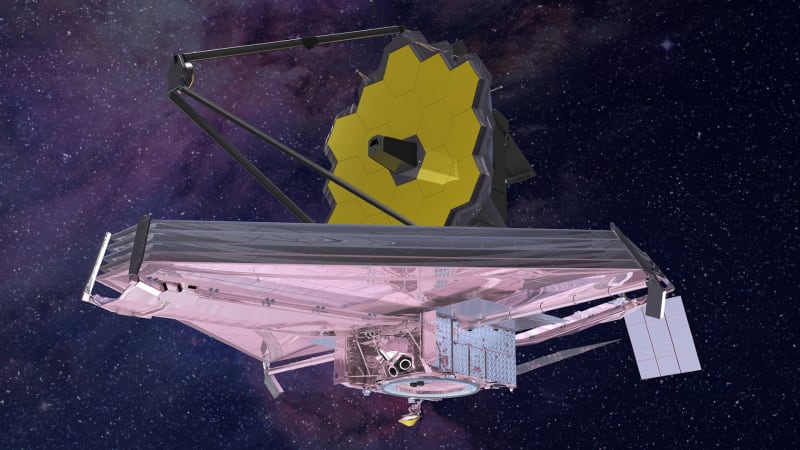
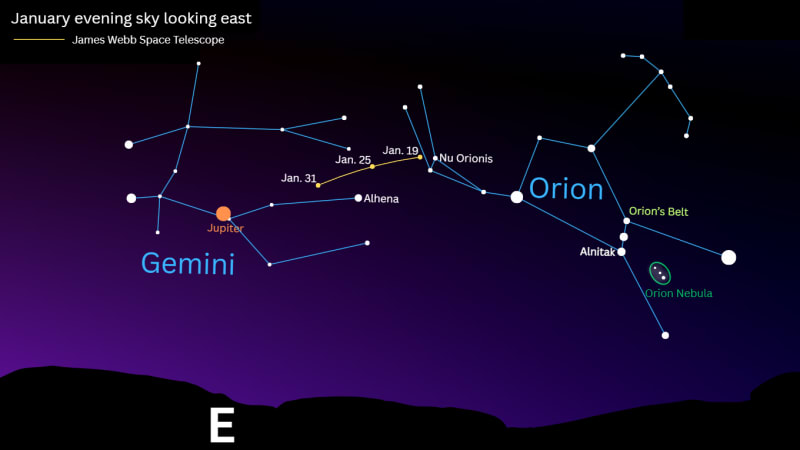
The James Webb Space Telescope, launched on Christmas Day 2021, currently travels across the eastern horizon after sunset. On January 19, you'll find it near the star Nu Orionis in the constellation Orion, slowly making its way toward bright Jupiter over the next two weeks.
While you're looking at Orion, take a moment to find the three stars of Orion's Belt. Just below the bottom star lies the stunning Orion Nebula, one of Webb's many astronomy targets and visible even without a telescope as a milky blur of light.
The Europa Clipper spacecraft launched in October 2024 on a six-year journey to Jupiter's icy moon Europa. In mid-January around 3 a.m., you can find its position near the constellation Libra, which rises in the southeastern sky.
This intrepid explorer will travel 1.8 billion miles before arriving at Jupiter in April 2030. Once there, it will perform 49 close flybys of Europa to study whether the moon's hidden ocean could support life.
Europe's Jupiter Icy Moons Explorer (JUICE) follows a similar path, scheduled to arrive at Jupiter in July 2031. Together with Europa Clipper, these missions will unlock secrets about gas giants and the mysterious oceans beneath icy moon surfaces.
The Bright Side
These spacecraft remind us that human curiosity knows no bounds. While we'll never see these robots again with our own eyes, their missions expand our understanding of the universe and inspire the next generation of explorers here on Earth.
Tracking spacecraft positions connects us to humanity's greatest adventures. Each patch of sky containing these distant travelers represents our collective dreams of discovery, working tirelessly to answer questions about our place in the cosmos.
More Images
Based on reporting by Space.com
This story was written by BrightWire based on verified news reports.
Spread the positivity!
Share this good news with someone who needs it