40,000-Year-Old Symbols Show Humans Recorded Information
Ice Age humans carved complex symbol sequences into ivory figurines 40,000 years ago that rival early writing systems in sophistication. New research reveals these weren't random decorations but structured information storage that predates formal writing by tens of thousands of years.
Long before humans invented writing, our Ice Age ancestors were already recording information in surprisingly sophisticated ways.
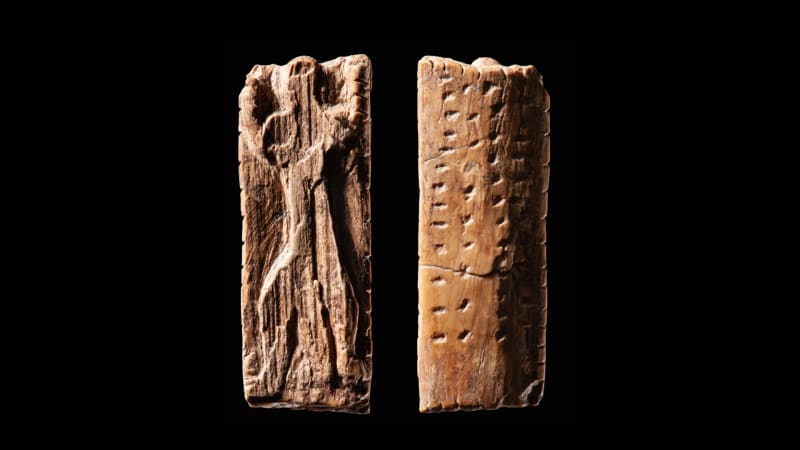
Researchers at Saarland University and Berlin's Museum of Prehistory have discovered that geometric symbols carved into tools and figurines over 40,000 years ago weren't simple decorations. These patterns of dots, lines, crosses, and notches were structured sequences used to communicate or store information.
The team analyzed more than 3,000 symbols across 260 ancient objects, many found in caves throughout Germany's Swabian Jura region. One standout artifact is a small mammoth figurine from Vogelherd Cave, its ivory surface marked with neat rows of crosses and dots. Another piece, called the Adorant, shows a lion-human hybrid figure surrounded by deliberately placed notches and dots.
What makes this discovery remarkable is how complex these early symbols were. Using computational techniques to measure information density, linguist Christian Bentz found that these Paleolithic markings match the sophistication of proto-cuneiform, the earliest known writing system that emerged around 3,000 B.C.E. That's roughly 40,000 years later.
"Our research is helping us uncover the unique statistical properties of these sign systems, which are an early predecessor to writing," says Bentz. The signs show patterns and predictability that indicate intentional meaning, not random decoration.
The symbols don't represent spoken language the way modern writing does. Instead, they feature heavy repetition like "cross, cross, cross, line, line, line" that suggests a different type of information system. Yet their overall complexity mirrors that of humanity's first formal scripts from ancient Mesopotamia.
Archaeologist Ewa Dutkiewicz notes that figurines carry higher information density than tools do, hinting that different objects served different communication purposes. The team continues traveling across Europe to document more examples, convinced they've only scratched the surface.
Why This Inspires
This research rewrites our understanding of human cognitive development. Our ancestors weren't just surviving in harsh Ice Age conditions. They were thinking abstractly, developing systems to preserve knowledge across generations, and laying groundwork for one of humanity's greatest achievements: writing.
The discovery shows that the human drive to communicate complex ideas and remember important information goes back far deeper than we imagined. These ancient symbol makers were doing something profoundly human, creating a bridge between their world and ours that spans 40 millennia.
Today's researchers continue uncovering new sequences, revealing that innovation and information sharing have always been core to who we are as a species.
Based on reporting by Science Daily
This story was written by BrightWire based on verified news reports.
Spread the positivity!
Share this good news with someone who needs it