5 Indian Students Build AI Tools for Farms and Healthcare
While a robotic dog scandal made headlines at India's AI summit, five student teams quietly showcased real solutions for crop disease, newborn care, and navigation for the blind. Their innovations are already earning patents and national awards.
A robotic dog drew crowds at New Delhi's India AI Impact Summit on February 17, 2026, but the applause turned sour when viewers recognized it as a commercially available Chinese robot. Galgotias University was asked to vacate its stall by day's end.
That moment could have defined India's student AI story as hype over substance. But walk past the controversy, and you'll find five student projects solving problems that actually matter to people.
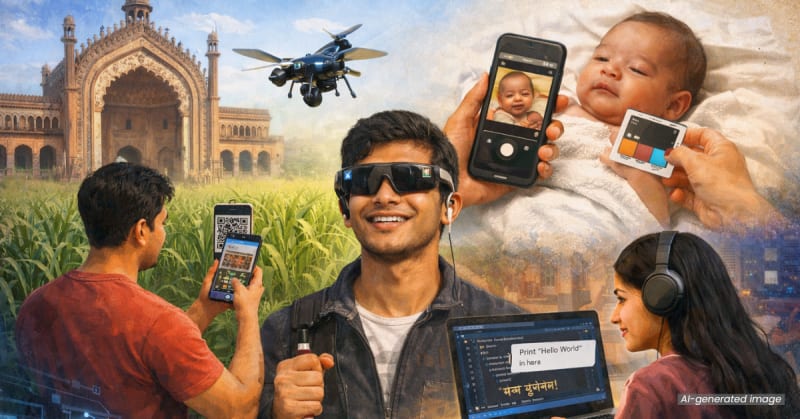
At Dr APJ Abdul Kalam Technical University in Lucknow, 30 first-year students built HeritageLens, a mobile app that turns heritage sites into interactive experiences. Scan a QR code at Rumi Darwaza, and the app delivers guided tours in Hindi and English, complete with entry prices and nearby restaurants.
The smart design choice is offline mode, so you can access everything even when mobile data drops in crowded tourist zones. The students built it during a 10-week training program focused on practical applications.
Researchers from SGSITS Indore and Delhi Technological University created something farmers desperately need: a butterfly-shaped flying robot that detects sugarcane disease early. The AI-powered device navigates through dense crops, captures close-up leaf images, and uses GPS to mark exactly where infections like red rot and wilt appear.
Instead of spraying entire fields, farmers can treat only the affected patches. The robot connects to a web platform that builds heat maps and sends alerts, and the project has already filed a patent.
Tushar Shaw, a second-year student at Scaler School of Technology in Bengaluru, designed Perceivia, smart glasses for people with visual impairments. Sensors and AI work together to recognize objects and offer guidance through audio cues and vibration feedback.
Perceivia won Samsung Solve for Tomorrow 2025 and earned incubation support at IIT Delhi, where prototypes get refined for real-world use. For someone navigating an unfamiliar street, that clearer read of obstacles can transform a risky commute into a manageable one.
Anshumaan Karna, a third-year computer science student at IIIT Naya Raipur, tackled newborn jaundice screening with a smartphone app. The AI analyzes skin images to estimate bilirubin levels without invasive tests.
He included a 3D-printed color card fixture to standardize photos, because camera-based screening fails when lighting varies or colors get misread. That simple addition makes the difference between useful data and false readings.
The Ripple Effect
These projects share something the robotic dog demo lacked: they start with a specific problem someone actually faces. A farmer checking crops in the heat, a parent worried about their newborn, a person navigating a busy intersection without sight.
The India AI Impact Summit may have opened with spectacle, but it closed with substance. These five teams proved that real innovation doesn't need flash when it's built on purpose.
More Images
%2Fenglish-betterindia%2Fmedia%2Fmedia_files%2F2026%2F02%2F18%2Ffeatured-img-2026-02-18-18-11-08.png)
%2Ffilters%3Aformat(webp)%2Fenglish-betterindia%2Fmedia%2Fmedia_files%2F2026%2F02%2F18%2Ffeatured-img-1-2026-02-18-18-15-40.png)
%2Ffilters%3Aformat(webp)%2Fenglish-betterindia%2Fmedia%2Fmedia_files%2F2026%2F02%2F18%2Ffeatured-img-2-2026-02-18-18-17-22.png)
Based on reporting by The Better India
This story was written by BrightWire based on verified news reports.
Spread the positivity!
Share this good news with someone who needs it