50-Year Space Mystery Solved by New X-Ray Telescope
After half a century of confusion, scientists finally discovered why a giant star in Cassiopeia flickers with mysterious X-rays. The answer reveals a rare cosmic pairing that rewrites our understanding of how stars evolve together.
For 50 years, astronomers watched a massive blue star pulse with powerful X-rays and couldn't figure out why. Now, cutting-edge space telescope observations have cracked the case, revealing a tiny invisible companion star that's been hiding in plain sight all along.
The star gamma Cassiopeia sits 550 light-years away, bright enough to mark the middle peak of the famous W-shaped constellation visible in the northern sky. When scientists first spotted its bizarre X-ray signature in the 1970s, it blazed 40 times brighter than any star of its type should, with plasma heated to a scorching 150 million degrees.
The problem was finding what caused it. The main star is 15 times the mass of our Sun, impossibly bright and hot. If a tiny companion star orbited nearby, it would be completely invisible against that blazing backdrop.
Enter XRISM, a powerful new X-ray telescope launched jointly by space agencies from Japan, Europe, and the United States. Between December 2024 and June 2025, the satellite captured detailed observations that revealed the truth.
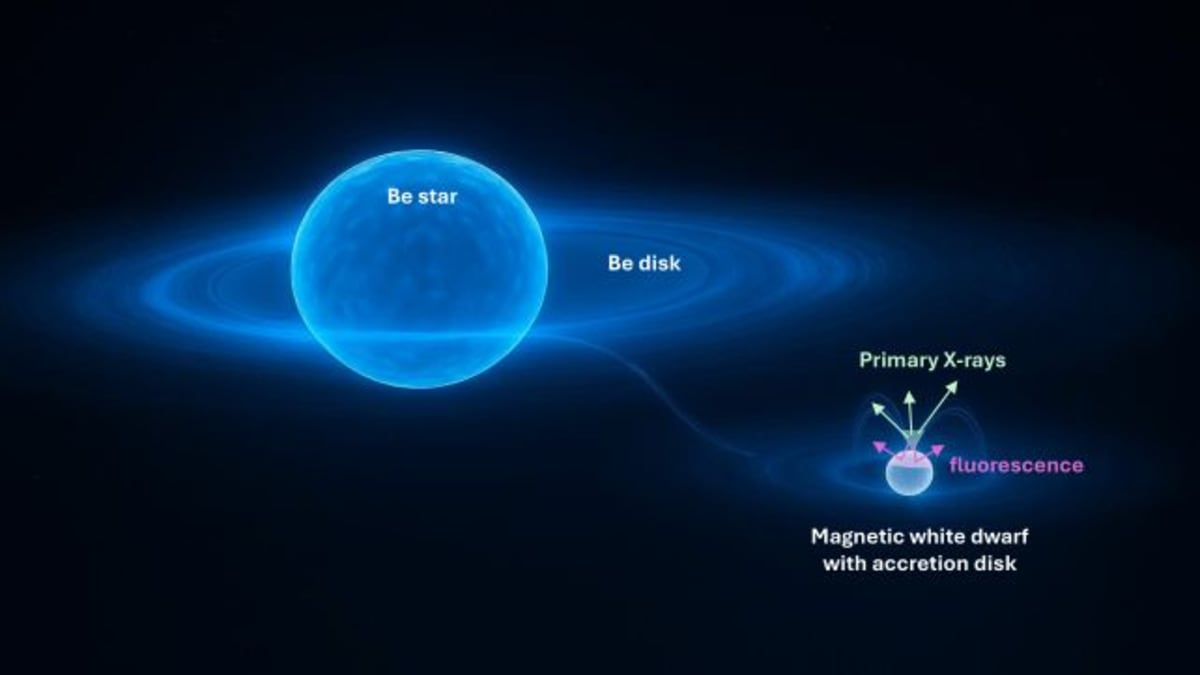
The X-ray signature followed a rhythmic 203-day pattern, the telltale sign of something orbiting the giant star. That something turned out to be a white dwarf, the ultra-dense dead core of a star that once burned bright but collapsed to roughly Earth's size.
As the two stars orbit each other, the white dwarf's intense gravity pulls material from its larger companion. That stolen gas funnels along magnetic field lines and slams into the white dwarf's surface, heating to extreme temperatures and creating the mysterious X-rays astronomers had puzzled over for decades.
Why This Inspires
This discovery confirms something scientists long predicted but struggled to prove: Be stars and white dwarfs can form stable pairs. These odd couples actually represent a natural stage in how binary star systems evolve over billions of years.
The breakthrough gives astronomers a new tool for understanding similar signals around other stars. Gamma Cassiopeia, the very first Be star ever identified back in 1866, continues to teach us fundamental lessons about how the universe works.
"There has been an intense effort to solve the mystery across many research groups for many decades," says astrophysicist Yaël Nazé of the University of Liège in Belgium. "And now, thanks to high-precision observations, we have finally done it."
Sometimes the most profound discoveries come from patient observation and better tools. After half a century of watching and wondering, humanity finally has its answer written in X-rays across the cosmos.
More Images



Based on reporting by Google News - Science
This story was written by BrightWire based on verified news reports.
Spread the positivity!
Share this good news with someone who needs it