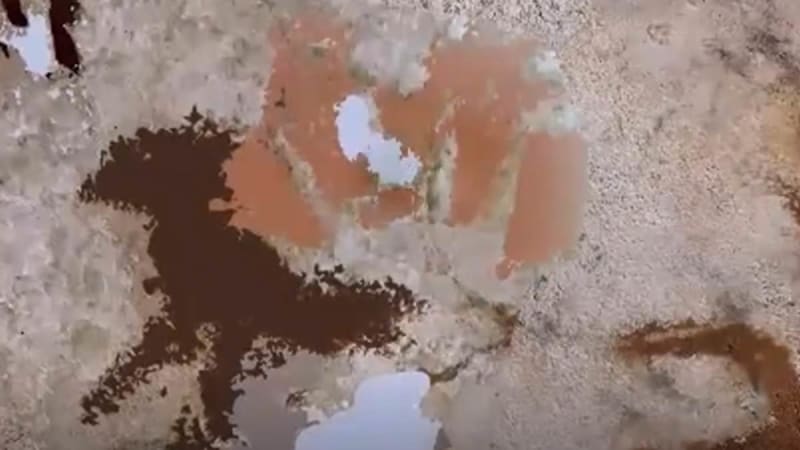
67,000-Year-Old Hand Art Found in Indonesian Cave
Scientists just discovered the world's oldest cave art in Indonesia: a red hand stencil created at least 67,800 years ago. The find rewrites what we know about human creativity and helps solve mysteries about how our ancestors first reached Australia.
A red hand painted on a cave wall in Indonesia has just claimed the title of humanity's oldest known artwork, created at least 67,800 years ago by our ancient ancestors.
The discovery happened in limestone caves on Muna, a small island near Sulawesi in southeastern Indonesia. Researchers from Griffith University used cutting-edge uranium dating techniques to analyze tiny mineral deposits on the painting, revealing it predates the previous record holder by 15,000 years.
What makes this hand stencil even more fascinating is that its creator deliberately altered it. The fingers appear narrowed and claw-like, suggesting our ancestors weren't just making art for art's sake but imbuing it with meaning.
Professor Adam Brumm, who co-led the study, believes the claw-like hand could symbolize the deep connection early humans felt with animals. Other cave art in the region shows part-human, part-animal figures, hinting at a rich spiritual world these ancient people inhabited.
The cave held another surprise: paintings dating back just 20,000 years were found alongside the ancient hand. This means people returned to this special place to create art for an incredible 47,000-year span, making it one of the world's longest-running art studios.
The Ripple Effect
This discovery does more than push back the timeline of human creativity. It helps solve a puzzle archaeologists have debated for decades: when and how did humans first reach Australia?
The timing and location of this ancient art strongly suggests that the painters were part of the wave of people who migrated through Sulawesi on their way to Australia at least 65,000 years ago. Professor Renaud Joannes-Boyau calls it "the oldest direct evidence for the presence of modern humans along this northern migration corridor."
The finding settles two major scientific debates at once, confirming both the timing (at least 65,000 years ago) and the route (through Sulawesi and nearby islands) of humanity's journey to the Australian continent.
Professor Maxime Aubert, another co-lead author, emphasizes that Sulawesi was clearly "home to one of the world's richest and most longstanding artistic cultures." These weren't scattered doodles but part of a sophisticated tradition passed down through hundreds of generations.
Our ancestors who painted that red hand couldn't have imagined that 67,800 years later, their artwork would still be telling their story and helping us understand our shared human journey.
Based on reporting by Google News - Scientists Discover
This story was written by BrightWire based on verified news reports.
Spread the positivity!
Share this good news with someone who needs it
%2Ffile%2Fattachments%2F2997%2F36Thulamela_Archaeological_Research_Field_Trip_Sept_2025_035_372816.jpg)