
7-Million-Year-Old Fossil Reveals Earliest Human Ancestor Walked Upright
Scientists at New York University have made a groundbreaking discovery that rewrites human history. A tiny bump on an ancient fossil from Chad confirms our earliest known ancestor walked on two legs 7 million years ago, bringing us closer to understanding our remarkable evolutionary journey.
In an exciting breakthrough that sheds new light on human origins, researchers have confirmed that Sahelanthropus tchadensis, a 7 million-year-old fossil ape discovered in Chad, walked upright on two legs. This discovery makes it the earliest known member of the human family tree, offering a fascinating glimpse into our ancient past.
The key to unlocking this mystery was surprisingly simple: a small bump on the ancient creature's thigh bone that had never been noticed before. Scott A. Williams, an associate professor of paleoanthropology at New York University, made the discovery in the most tactile way possible. "It's a very subtle little bump that I actually didn't identify initially by looking at the fossil but by rubbing my thumb along it and bumping into it," Williams shared with enthusiasm.
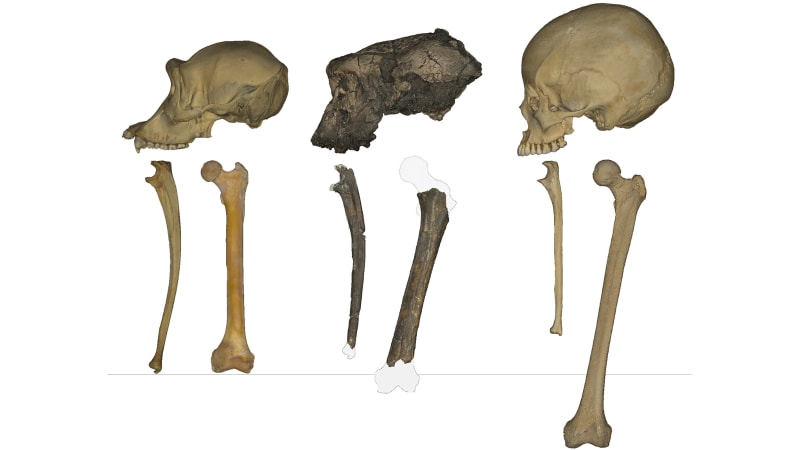
This tiny feature, called the femoral tubercle, is found only in members of the human lineage. Its presence on a 7 million-year-old fossil is nothing short of remarkable. Williams and his team didn't stop there. They carefully analyzed 3D scans of the limb bones and compared them to every living and extinct ape species with known thigh bones. Their thorough investigation revealed two additional human-like features: the bone twisted inward, placing the knees closer together like modern humans, and there was a distinct attachment point for the largest glute muscle, which isn't found in living nonhuman apes.
What makes this discovery even more captivating is that Sahelanthropus tchadensis lived around the time scientists believe the last common ancestor of humans and chimpanzees existed. The fossil shows a beautiful blend of characteristics. Its curved arm bones suggest it was perfectly adapted to climbing trees like modern chimpanzees, but its hips and knees functioned like those of our human ancestors. This tells a story of a creature transitioning between two worlds, spending significant time on the ground while maintaining its tree-climbing abilities.
The Ripple Effect
This discovery is transforming how scientists understand human evolution. Jeremy DeSilva, a biological anthropologist at Dartmouth College, called the findings "beyond convincing" and admitted he wished he had spotted these features himself when examining the fossil scans. The research is opening up exciting new questions about what our earliest ancestors looked like and how they lived.
The study, published in the journal Science Advances, represents more than twenty years of careful analysis since the fossil was first described in 2002. It demonstrates the power of patient, meticulous scientific work and shows how new technologies like 3D scanning can reveal secrets that have been hiding in plain sight for decades.
This breakthrough reminds us of the incredible journey our species has taken. Every fossil tells a story, and this one speaks of a pivotal moment when our ancestors took their first steps toward becoming human. It's a testament to human curiosity and our endless drive to understand where we came from. As researchers continue to study these ancient remains, we can look forward to even more revelations about our fascinating evolutionary heritage.
More Images

Based on reporting by Google: fossil discovery
This story was written by BrightWire based on verified news reports.
Spread the positivity! 🌟
Share this good news with someone who needs it
More Good News

DAILY MORALE
What did the thermometer say to the graduated cylinder?
EXPLORE INTEL
DAILY INSPIRATION
Hope is the thing with feathers that perches in the soul and sings the tune without the words and never stops at all.
Emily Dickinson