
7-Million-Year-Old Fossil Reveals Exciting New Chapter in Human Origins Story
Scientists have made a thrilling discovery that rewrites our understanding of human evolution. A tiny bump on an ancient ape's leg bone confirms our earliest ancestor walked upright 7 million years ago, offering fascinating new insights into how humanity began its incredible journey.
In an exciting breakthrough that illuminates humanity's remarkable origins, researchers have confirmed that our earliest known ancestor was walking upright on two legs an astonishing 7 million years ago. The discovery of a small but significant bump on the fossilized leg bone of Sahelanthropus tchadensis has solved a decades-old mystery and opened a captivating new window into how we became human.
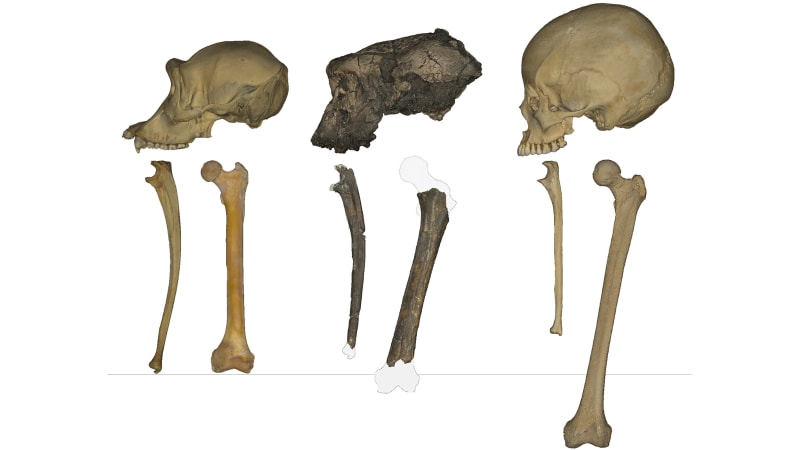
The breakthrough came when Scott A. Williams, a paleoanthropology professor at New York University, was examining 3D scans of the ancient bones. In a moment that showcases the beautiful detective work of science, Williams made his discovery not just by looking, but by feeling. Running his thumb along the femur, he found a subtle bump that changed everything. This tiny lump, called the femoral tubercle, exists only in members of the human family tree.
"That really convinced me that, OK, we think it's a biped, and therefore, we think it's a member of the hominin lineage," Williams shared with enthusiasm. The finding represents years of careful analysis and collaboration, published in the prestigious journal Science Advances on January 2.
The research team's detailed examination revealed three wonderfully human-like features in this ancient ancestor. The femur bone twisted inward, placing the knees closer together than the hips, just like modern humans. A distinct lump showed where the largest glute muscle attached, a feature absent in today's non-human apes. And most tellingly, that small bump proved this species frequently walked on two legs while on the ground.
What makes this discovery even more fascinating is that S. tchadensis, found in present-day Chad, appears to have lived the best of both worlds. Its curved arm bones suggest it was perfectly adapted to climbing trees like modern chimpanzees, yet its hips and knees functioned like those of our human ancestors. This remarkable creature represents a pivotal moment in evolutionary history, showing us the gradual, beautiful process of adaptation that eventually led to humanity.
The Bright Side: This discovery does more than solve an ancient puzzle. It reveals the incredible journey our ancestors took and highlights the persistent curiosity of scientists who spent over two decades carefully analyzing these precious fossils. Since S. tchadensis was first described in 2002, researchers have debated its place in our family tree. Now, through meticulous work and innovative techniques like 3D scanning, we have our answer.
Jeremy DeSilva, a biological anthropologist at Dartmouth College, captured the excitement of the scientific community perfectly. "It's beyond convincing," he said, expressing both admiration and a touch of friendly regret at not spotting the features himself. This kind of collaborative spirit and shared wonder exemplifies the best of scientific discovery.
The finding also raises intriguing new questions that will fuel future research. What did the last common ancestor between humans and chimpanzees really look like? How did bipedalism first evolve? These questions remind us that every answer in science opens doors to new mysteries, keeping the adventure of discovery alive.
This ancient ape, walking upright across African landscapes 7 million years ago, represents not just our past but our incredible capacity to understand it. Through patience, technology, and human ingenuity, we continue uncovering the amazing story of where we came from.
More Images

Based on reporting by Live Science
This story was written by BrightWire based on verified news reports.
Spread the positivity! 🌟
Share this good news with someone who needs it
More Good News
Planet Wins7-Million-Year-Old Fossil Reveals Earliest Human Ancestor Walked Upright
 Planet Wins
Morocco Fossil Discovery: 700,000-Year-Old Ancestor Unlocks Human Origins Mystery
Morocco Cave Fossils Reveal 773,000-Year-Old Link in Human Family Tree
DAILY MORALE
What did the thermometer say to the graduated cylinder?
EXPLORE INTEL
DAILY INSPIRATION
Hope is the thing with feathers that perches in the soul and sings the tune without the words and never stops at all.
Emily Dickinson