89% of Nigerians Back Women Leaders Despite Workplace Gaps
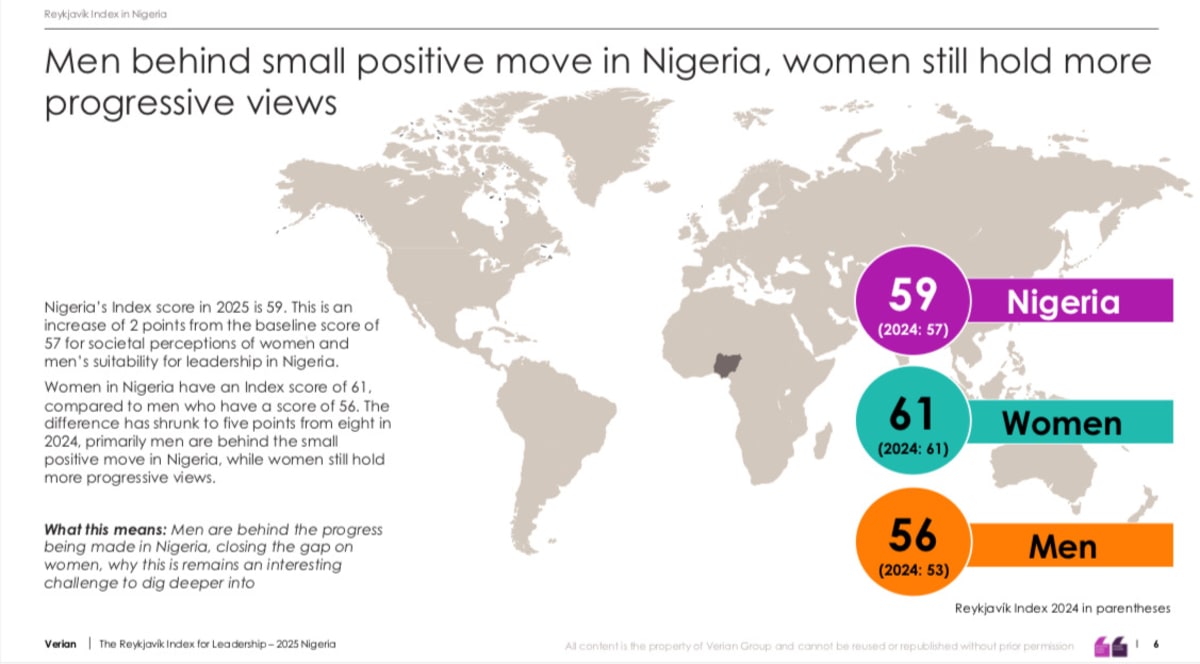
Nearly nine in 10 Nigerians support women leading major companies, revealing attitudes have shifted far ahead of institutions. The nation's leadership readiness score climbed to 59 in 2025, but workplace equality perceptions dropped sharply.
Public support for women leaders in Nigeria has reached a striking high, but the country's institutions haven't caught up yet.
A new leadership study shows 89% of Nigerians feel comfortable with women running major companies, while 77% support women as political leaders. Nigeria's overall leadership readiness score rose from 57 to 59 in 2025, reflecting growing confidence in women's capabilities across sectors.
The Reykjavik Index for Leadership report, presented by advocacy group Gatefield, reveals a critical gap between public acceptance and real opportunities. While nearly nine in 10 Nigerians embrace women leaders, only 55% believe workplace equality actually exists, creating a 34-point divide between attitude and reality.
That workplace equality number tells an important story. It dropped seven points from 62% in 2024, marking the steepest decline of any metric measured. Researchers suggest economic pressures may have hit women harder through discriminatory layoffs, or that growing awareness is helping people recognize barriers they once overlooked.
Men's perceptions shifted notably too. Their leadership acceptance score climbed from 53 to 56, driven largely by older men expressing stronger support. Surprisingly, men feel more pessimistic about workplace equality than women do, with only 52% believing it exists compared to 58% of women.
The Ripple Effect
The corporate world is leading where politics lags behind. Women hold 31% of board seats at Nigeria's largest companies but only 4.2% of parliamentary seats. Banking, finance, education and pharmaceuticals show the strongest gender equity, proving intentional policies like leadership quotas create measurable change.
Sectors traditionally led by women scored lowest on the index. Childcare ranked at just 33 points, a full 40 points below banking and finance at 73. Fashion and beauty, despite generating billions annually in Nigeria and being largely woman-led, scored only 46 points.
Experts say this reveals a blind spot in how equality efforts focus almost exclusively on getting women into male-dominated fields while ignoring industries where women already lead. Strengthening the care and creative economies could unlock billions in economic growth and create countless jobs.
The message from advocates is clear: public attitudes have evolved, but institutions need to match that progress with real reforms. With 77% of Nigerians comfortable with a female head of state, the groundwork for transformation already exists.
Nigeria's shifting attitudes prove that cultural acceptance can move faster than systems, and now those systems have some serious catching up to do.
More Images



Based on reporting by Premium Times Nigeria
This story was written by BrightWire based on verified news reports.
Spread the positivity!
Share this good news with someone who needs it