A $7,500 Grant Launched the Entire AI Revolution
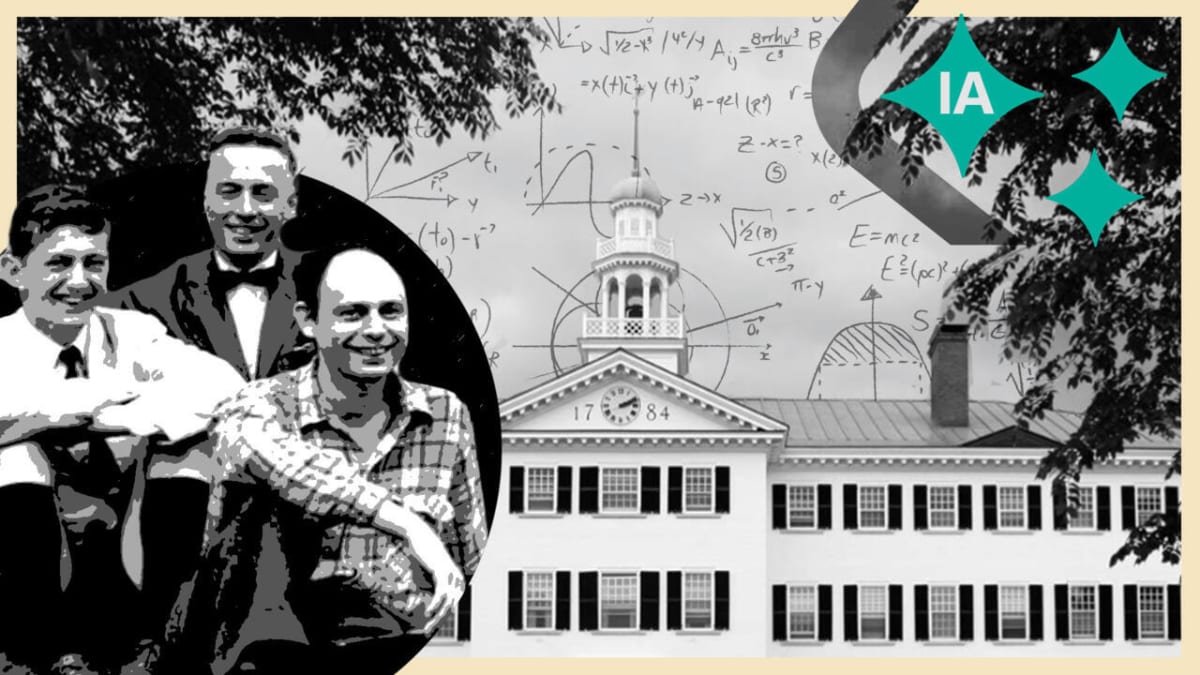
In 1956, the Rockefeller Foundation invested just $7,500 in a summer workshop that would change technology forever. That modest grant funded the Dartmouth Conference where "artificial intelligence" was born as a field of study.
Seventy years ago, a young mathematician named John McCarthy had a wild idea for a summer conference about machines that could think. The Rockefeller Foundation almost turned him down.
McCarthy first asked for $13,500 in 1955 to gather researchers at Dartmouth College to explore something called "artificial intelligence." Foundation administrators scratched their heads. Why spend the equivalent of $160,000 today on a field that didn't even exist yet?
But McCarthy wasn't working alone. He teamed up with fellow math prodigy Marvin Minsky and convinced some heavy hitters to join them. Nathaniel Rochester, who invented IBM's first commercial computer, signed on. So did Claude Shannon, already famous for groundbreaking work in mathematical communication theory.
Their proposal promised to explore neural networks, teaching computers to use language, and even machine "self-improvement." Today we'd call that deep learning. Still, it was a tough sell.
Warren Weaver, director of Natural Sciences at the foundation, saw promise in the idea. He'd funded breakthrough projects in genetics and molecular engineering before. But he thought the proposal sounded more like brain research than mathematics, so he passed it to Robert S. Morison, the medical research director.
Morison took a chance. He approved $7,500, making what would become the first investment in AI history.
In June 1956, the team moved into Dartmouth College apartments for five weeks. McCarthy initially wanted to call the field "Intelligent Machines," but Shannon thought that sounded too ambitious. They briefly considered "Automata Studies" before landing on "artificial intelligence."
The name stuck for good reasons beyond marketing. It defined a shared vision and created a starting point for an entire community of researchers to rally around.
The Ripple Effect
That single $7,500 grant planted seeds that grew into today's AI revolution. The Dartmouth Conference didn't produce immediate breakthroughs, but it brought together mathematicians, philosophers, and economists to dream about intelligent machines. It created the foundation for decades of research that followed.
Now billions pour into AI companies like OpenAI and Anthropic. Modern AI helps doctors diagnose diseases, assists people with disabilities, and tackles climate challenges. The technology McCarthy and his colleagues imagined in those Dartmouth apartments is helping solve real problems for real people.
The foundation's modest investment shows how betting on bold ideas, even unproven ones, can change the world in ways nobody imagines.
More Images
Based on reporting by France 24 English
This story was written by BrightWire based on verified news reports.
Spread the positivity!
Share this good news with someone who needs it